
Newsletter – 2023 – April
President's Message
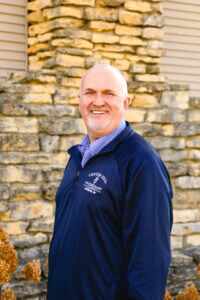 From the DCRC President’s Desk
By William “BJ” Jones, DVM
Happy Spring from Southwest Wisconsin! Or should I say, “Happy mud season”? For those of you who don’t know me, I work as a practicing large animal veterinarian in Darlington, Wis.
Recently, I pulled into a farm for a weekly herd visit and the dairyman could barely contain his glee. As he approached me, he had a big old smile and said, “Doc, you sure need to learn how to count!” Now I am used to some good-natured ribbing, but this one sure had me wondering what he was referring to. “Frank, what do you mean?” I asked. Frank retorted once again that I sure didn’t know how to count. After a little back and forth, he asked, “Do you remember that cow that you ultrasounded with triplets?” Well, I did and I asked, “Yes, what happened? Did she only have twins?” He laughed again and said “Nope, she had four of them!” I rolled my eyes in disbelief. While I do diagnose about four triplet pregnancies each year, I have never diagnosed quadruplets in my 26-year veterinary career. That got my old vet brain thinking about what are the chances of quadruplets from a Holstein cow? While that number can be a little hard to track down, it sounds like one of 700,000 calvings can yield quadruplets. We all know the risks multiple births pose to the health of our dairy cows. I am hoping that is the last set of quadruplets I see in my career.
Plans are underway for the DCRC Annual Meeting in Salt Lake City, Nov. 14-17. We will have top speakers and up-to-date research about topics that affect our industry with tips to help you get cows bred and improve profitability, along with some of the latest on sustainability. We have been rotating the regions of the meeting to make it easier for folks from different parts of the country to attend. I hope to see some of our western dairy producers this year. The 2023 DCRC Annual Meeting will have a special post-conference event in conjunction with the Academy of Dairy Veterinary Consultants. Plans are underway to go in depth with dairy data analytics with some hands-on opportunities. Keep an eye out in our newsletters and website for details in the coming months.
One fun event I enjoy at our annual meeting every year is the presentation of the DCRC Excellence in Dairy Reproduction Awards, sponsored by Hoard’s Dairyman magazine and DCRC. We recognize the top herds in the country for reproductive efficiency and outstanding management practices. If you are a professional in the industry that works with herds with outstanding reproduction, please nominate these herds for the award. The nomination process is easy and available on our website. I encourage veterinarians, genetic and pharmaceutical company representatives, DHIA field personnel and Extension specialists to fill out this application for deserving herds. The top herds receive a stipend to attend our annual meeting. Nominations close April 30.
If you are a graduate student, be sure to check out the DRCR Scholar program! DCRC will provide free registration and travel funds, up to $1,500, for a graduate student, who is a DCRC member, to attend the annual meeting. Note the deadline is April 30 and the scholarship application is available on our website.
In closing, I encourage you to check out the Members Only section on the DCRC website. A tremendous amount of information is available there. (If you need assistance accessing the DCRC Members Only webpage, contact Kyle Wieskus at: kyle@dcrcouncil.org.) In addition to the proceedings from our 18 years of annual meetings, we also have more than 50 webinar recordings available, including some presented in Spanish and Portuguese. A wealth of information is available at your fingertips!
Research Summaries
Do calving-related injuries of the vestibulum vaginae and the vagina affect the reproductive performance in primiparous dairy cows?
Marien, N. Gundling, W. Hasseler, M. Feldmann, K. Herzog, and M. Hoedemaker
One of the major goals during the transition period is to avoid calving-related problems, such as dystocia and uterine diseases. However, dystocia may be inevitable in some cases and proper management, such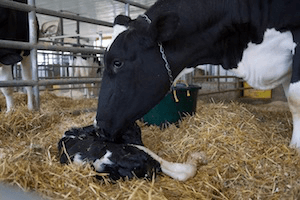 as early interventions by trained personnel, play an important role in avoiding calving-related injuries of the vestibulum vaginae and the vagina. The goal of this study was to evaluate the impact of these injuries on the fertility of primiparous cows.
Animals included, lesions definitions, and fertility outcomes
In this observational study, 236 primiparous cows from one herd in Germany were enrolled:
- Lesions were evaluated one day after calving, based on location, depth, and length.
- Vestibulum vaginae injuries were scored as: 0, no injuries presented; 1, injuries less than 2 cm deep; and 2, severe injuries equal or greater than 2 cm deep.
- Vaginal injuries were scored as: 0, no injuries; 1, lesion less than 2 cm deep and up to 10 cm long; 2, lesion equal or greater than 2 cm deep and/or equal or greater than 10 cm long.
- Lesion healing was evaluated for up to 42 days postpartum.
- Outcomes of interest were the incidence of metritis and purulent vaginal discharge, interval from calving to first insemination, days open, interval from first insemination to conception, calving interval, first service conception rate, and proportion of animals pregnant at 200 days postpartum.
Results
- Only 12.3% of the animals did not present any lesion in the vagina or vestibulum vaginae, and severe lesions took longer to heal than mild lesions.
- Calving ease was associated with birth soft tissue injuries, with dystocia being associated with severity of injuries.
- Metritis incidence was high (62.6%); the greater severity of the injuries, the greater the incidence of metritis.
- Purulent vaginal discharge incidence (41.3%) was also associated with severity of lesions.
- Injuries were not associated with fertility outcomes.
In conclusion, although birth canal soft tissue injuries were associated with greater incidence of postpartum diseases, such as metritis and purulent vaginal discharge, no statistically significant associations were observed between injuries and reproductive performance.
Access the paper at:https://www.ncbi.nlm.nih.gov/pmc/articles/PMC9862871/
Fertility and survival of Swedish Red and White × Holstein crossbred cows and purebred Holstein cows
D.F. Pipino, M. Piccardi, N. Lopez-Villalobos, R.E. Hickson, and M.I. Vázquez
Selection for greater milk production may have contributed to impaired fertility and survival in Holstein cows, which poses a great economic challenge for dairy farmers. Although, in recent years, genetic selection has also focused on fertility and longevity traits; due to their low heritability, it is unlikely that improvements in culling and reproductive performance will be noticeable in the short term. Crossbreeding, partially through heterosis, can lead to improvements on productivity, fertility, and survivability. Therefore, the goal of the study was to compare fertility and survivability traits of purebred Holstein and Swedish Red and White x Holstein crosses (S x H).
Study design, animals included, and traits evaluated
This was an observational study that included animals from two herds in Argentina:
- Data included 1,331 lactations from 576 Holstein cows and 506 lactations from 240 S x H cows.
- Reproductive management included artificial insemination (AI) after estrus detected by visual observation and tail paint and fixed-timed AI.
- Fertility traits included first service conception rate, overall conception rate (number of pregnancies divided by number of inseminations), services per conception, and days open.
- Longevity outcomes included mortality rate, culling rate, survival to subsequent calving, and length of productive life (number of days between first calving and culling or death).
Results
- All fertility traits were improved in S x H cows in comparison to Holstein counterparts during first and third or greater lactations. During second lactation, only services per conception and days open were improved for crossbred cows, in comparison to purebred Holsteins.
- Also, S x H cows had lower mortality and culling rates, in comparison to Holstein cows.
- Improvements in fertility and mortality/culling rates resulted in greater survival to second, third, and fourth calving for crossbred cows in comparison to Holstein counterparts.
- This led to greater length of productive life for S X H cows in comparison to purebred Holsteins.
In conclusion, crossbred S x H cows had improved fertility and survivability traits in comparison to Holstein cows, leading to the conclusion that crossbreeding may be an alternative strategy to improve reproductive performance and longevity of dairy cows. However, it is important to acknowledge that improvements in those traits may lead to decreased milk productivity and therefore a comprehensive analysis of performance should be considered before decisions related to crossbreeding Holstein cows.
Access the paper at:https://www.sciencedirect.com/science/article/pii/S0022030223000838?via%3Dihub
Longevity and the association with cattle health in Dutch dairy farms
P.I.H. Bisschop, I.M.G.A. Santman-Berends, G.H. Nijhoving, J. Muskens, and G. van Schaik
Due to legal constraints, the Netherlands has been focusing on reducing phosphate emissions per farm since 2017. They must be more efficient and increase longevity for it to be accomplished. Longevity is defined as the mean age at the moment of death, either through natural death, euthanasia, or slaughter of cows older than 2 years. The objective was to analyze the association between health and longevity in Dutch herds.
Animals included, group definitions, and longevity and health associations
In this observational study, data from 2016 to 2020 were compiled and 16,200 Dutch dairy herds were analyzed.
- Herds were grouped into six categories: high longevity (greater than 7 years old), increasing longevity (mean increase of 1 year and 2 months between 2017 and 2020), median longevity (approximately 5 years and 8 months), decreasing longevity (mean decrease 8 months), low longevity (less than 4 years and 10 months), and varying longevity of approximately 5 years and 8 months, with fluctuation in longevity throughout the study period.
- Statistics data were compiled at the herd and quarter levels. Using longevity and other management and herd-level factors as explanatory variables and health indicators as dependent variables, cattle health parameters were examined using multivariable population-averaged models.
Results
- For five of the six herd groupings identified, the mean lifespan on dairy farms increased during the study period.
- Only the herds chosen for a declining lifetime saw longevity drop. The mean lifespan in herds with high longevity was 7 years, whereas in herds with lower longevity it was 4 years and 10 months.
- In the group of herds with rising longevity, the mean longevity increased by an average of 1 year and 2 months.
- High longevity was associated with lower calf and cow mortality, a higher proportion of cows with a high somatic cell count (SCC), more inseminations per pregnancy for cows than for heifers, a higher use of antibiotics in adult dairy cows, and a lower use of antibiotics in calves.
- Additional investigation revealed that the larger proportion of older cows might account for the higher number of cows with a high SCC.
In conclusion, compared with the typical Dutch dairy herd, herds with low longevity exhibited higher calf and cow mortality, a smaller percentage of cows with high SCC, more inseminations for heifers than for cows, lower antibiotic use in cows, and higher antibiotic use in calves. This study demonstrated that herds with different longevity levels have different health characteristics in their cattle. In general, cow health appeared to be better in high-longevity herds than in low-longevity herds. The downside of having older cows is a higher chance of a high SCC, which can result in a greater need for antibiotics. Hence, pursuing limited antibiotic use and low bulk milk SCC may conflict with a goal of high longevity.
Access the paper at: https://pubmed.ncbi.nlm.nih.gov/36435144/
Featured Column
DCRC presents at international meeting
By Matthew Utt, DCRC past president
The Royal Association of British Dairy Farmers (RABDF) is an organization that was formed in 1876 to promote and improve the dairy industry in the United Kingdom. A major initiative of RABDF was to create and run the Dairy Show. This event had a heavy focus on showing animals for more than 100 years. In 2018, RABDF launched Dairy-Tech as a new event to promote technology and innovation in the UK dairy industry.
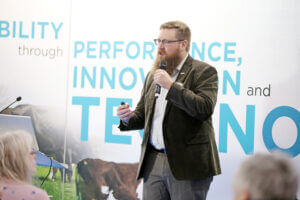 This year marked the fifth year of Dairy-Tech and I was honored to attend the event and represent the Dairy Cattle Reproduction Council (DCRC) and Zoetis. DCRC, along with PEAK Genetics, World Wide Sires and Zoetis, sponsored a program consisting of three speakers to present on sustainability, profitability and reproductive efficiency. Topics and presenters included “Sustainable dairying for the next 10 years and beyond,” by John Cole of PEAK Genetics; “Dairy profitability: Hitting the basics,” by Matt Utt of Zoetis; and “Using data to improve herd reproductive efficiency,” by John Cook of World Wide Sires. Renee Brod from the DCRC staff attended and took charge of the DCRC booth. We had a prime location – directly in front of the main entrance.
The evening before the one-day event, Renee, John Cole and I went to dinner with the RABDF board of trustees. It was a great dinner and time spent getting to know influential UK dairy producers. Although it was interesting to discuss differences between dairying in the United Kingdom compared to the United States, the general conversations about our vocations, lives and hot topics in our respective countries made for a wonderful evening. Dairy-Tech started off the next morning with a VIP breakfast hosted by Barclays, a UK bank and major sponsor of Dairy-Tech. Cole opened the event with his presentation, which was followed by mine in the Dairy Hub speaking area.
Cook’s presentation was held later in the day in the Innovation Hub. The presentation areas were very different from what we would see at a DCRC conference. The most notable difference was their location in the middle of trade show areas. There was mixed seating from risers to tables and chairs. People were walking around the trade show during the presentations. At first, I thought this might be distracting; however, I found that I liked it, specifically the casual atmosphere and surprisingly intimate setting amidst the trade show. All presentations were well attended and evoked good questions. After each of the DCRC presentations, speakers came back to the DCRC booth to interact with attendees.
What was Dairy-Tech like? The best way I can describe it is a combination between Western Dairy Management Conference and the World Dairy Expo trade show. I believe this event provided excellent visibility of DCRC to influential people in the UK dairy industry. RABDF was a wonderful host. The group’s hospitality made us feel welcome and truly a part of Dairy-Tech. Overall, I thought this was a great first step for DCRC to participate in an international event.
Featured Member
Editor’s Note: For each issue, DCRC interviews a member to learn more about his/her career, involvement with DCRC and thoughts about dairy cattle and reproduction. We encourage you to recommend someone for this feature by contacting JoDee Sattler at: JoDee@dcrcouncil.org
DCRC Scholar talks about his experience during the 2022 DCRC Annual Meeting
By Tony Bruinjé, PhD Candidate at the Ontario Veterinary College, University of Guelph
 This was my second time attending the DCRC Annual Meeting in person. It was an honor to be awarded the DCRC Scholar in 2020 and it was exciting to finally be able to attend the meeting in person again. It was a great way to present some of my PhD research and interact with researchers, students and consultants. Besides the excellent talk sessions that covered the most relevant topics on dairy cattle reproduction, the farm tour was a great way to take a closer look at dairies with outstanding reproductive success.
I grew up in the state of Paraná, Brazil, where I obtained my veterinary degree. During veterinary school, I became passionate about dairy cattle reproduction. I was intrigued by the rapidly growing possibilities to use technologies to optimize reproductive management. Thus, I was motivated to pursue graduate studies in reproductive management in North America. During my master’s degree program at the University of Alberta (Canada), I evaluated the use of an automated in-line milk progesterone analysis system to monitor reproductive function that can be applied in management of commercial herds. Later, I studied effects of early life nutrition on reproductive development in dairy heifers. I then moved to the Ontario Veterinary College at the University of Guelph, where I am in the last year of my PhD program. My main research project investigated impacts of peripartum health on reproductive function and performance on herds managed with activity monitors. One practical goal was to identify subgroups of cows more or less likely to be detected in estrus – to build a foundation for the development of selective management. My career aspirations are to contribute to the development and implementation of solutions for dairy management that involve optimization of use of data and precision technologies. Such strategies should not only result in more efficient management but also improve our understanding of dairy cow biology to enhance dairy cattle fertility, well-being and sustainability – all priorities for the dairy industry.
The DCRC Farm Tour was a unique opportunity to get a closer look at four outstanding dairies in Wisconsin: Schilling Farms, Kieler Farms, Darlington Ridge Farms and Wessel Farms. These farms achieve exceptional reproductive performance, with pregnancy rates greater than 35%. The producers, veterinarians and consultants spent a considerable amount of time with us and were open to answer any questions, which was really appreciated. Some of the key take-home aspects that all farmers mentioned as contributors to their success were teamwork and consistency. It was evident that success in reproductive management is a consequence of excellent transition cow management. Ultimately, this results in superior productivity.
The meeting program was very well planned and it included talks from top researchers and industry professionals delivering the most up-to-date, high-quality information on trending topics for dairy reproduction. Some of the topics that led to good discussions included early life factors associated with future performance, transition cow management, voluntary waiting period, strategic use of sexed semen, opportunities for beef-on-dairy and economics of selective replacements. Furthermore, the panel discussion with the award-winning producers was a great way to discuss the links between research and practical solutions for reproductive management.
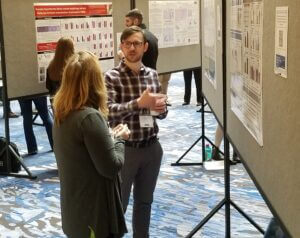
Having graduate students presenting their research findings during the poster session was a great way for attendees to get up to date on the upcoming topics on dairy reproduction. I had the opportunity to present two posters with data from my PhD work. One was on the associations of peripartum health with luteal function after first artificial insemination and endocrine signaling in early pregnancy. And the second poster was on pregnancy-associated glycoprotein measured prepartum and its associations with transition health. The interactions and discussions with other students, researchers and consultants were a great way to gain more insights and to learn more about scientific advancements on dairy reproduction and applications to dairy reproduction.
Being part of the 2022 DCRC Annual Meeting was motivating. Visiting outstanding dairies, attending the excellent presentations with the most up-to-date information that are directly relevant to the current and upcoming trends in dairy reproduction, and networking with other students, researchers and industry professionals were extremely valuable for my career. Once again, I thank DCRC for the opportunity to attend this event.
Industry Calendar
- National Conference on Interstate Milk Shipments, April 3-7, Indianapolis, Indiana
- Council on Dairy Cattle Breeding Triannual Evaluation, April 4
- Dairy Calf and Heifer Association Annual Conference and Trade Show, April 11-13, Prior Lake, Minnesota
- National Mastitis Council Regional Meeting, May 2-4, Visalia, California
- Animal Agriculture Alliance Stakeholders Summit, May 4-5, Arlington, Virginia
- International Committee for Animal Recording, May 22-26, Toledo, Spain
- American Dairy Science Association Annual Meeting, June 25-28, Ottawa, Ontario, Canada
- Council on Dairy Cattle Breeding Triannual Evaluation, August 8
- American Association of Bovine Practitioners Annual Conference, September 21-23, Milwaukee, Wisconsin
- World Dairy Expo, October 1-6, Madison, Wisconsin
- Council on Dairy Cattle Breeding Industry Meeting, October 4, Madison, Wisconsin
- Dairy Cattle Reproduction Council Annual Meeting, November 14-17, Salt Lake City, Utah
- Council on Dairy Cattle Breeding Triannual Evaluation, December 5
- National Mastitis Council Annual Meeting, January 29-February 1, Dallas, Texas
- World Ag Expo, February 13-15, Tulare, California
- Central Plains Dairy Expo, March 19-21, Sioux Falls, South Dakota
