
Newsletter – 2024 – June
President's Message
By Tracy Burnett, University of Guelph, Ridgetown Campus

DCRC President, Tracy Burnett
I hope everyone has had an excellent spring and is excited for a productive summer ahead!
The 2024 DCRC Scholar Program and nominations for our Excellence in Dairy Reproduction Awards Program have come to a close for this year.
We announced the DCRC Scholar winner, Briza Castro, in a news release in late May. Briza is from the University of Wisconsin with advisor Sofia Ortega. Her PhD work focuses on oocyte physiology in dairy heifers to improve the success of assisted reproductive technologies within reproductive programs. Along with her research, she is active in mentorship and teaching assistance with a passion to educate and inspire those around her. Congratulations to Briza on this outstanding accomplishment!
In addition to our Scholar Program, we received nominations for our Excellence in Dairy Reproduction Awards program. This year we received 75 nominations from all around the world. Nominations came in from eight countries, including China, Italy, Pakistan, Slovakia and the Czech Republic. Of these 75 nominations, 39 became finalists. We will announce the Bronze, Silver, Gold and Platinum winners during our annual meeting, which will be held in Arlington, Texas, Nov. 12-14.
I would also like to thank our May webinar speakers Francisco Peñagaricano and Michael Ballou for their educational talks within our webinar series. Peñagaricano discussed the effective use of genomics to improve dairy cow health and fertility in Spanish, while Ballou spoke about early life calf health and performance and their long-term impacts on lifetime health and (re)productive performance. If you missed these webinars, or any of our excellent presentations in the past, they are available in our online library for DCRC members. If you have a topic you would love to learn more about, please do not hesitate to reach out with ideas for future presentations for our webinar series!
I wish you all the best and hope everyone can find a bit of time to relax and spend time with friends and family over the summer season!
Research Summaries
Evaluating differences in milk production, reproductive performance, and survival associated with vaginal discharge characteristics and fever in postpartum dairy cows
C.C. Figueiredo, S. Casaro, F. Cunha, V.R. Merenda, E.B. de Oliveira, P. Pinedo, J.E.P. Santos, R.C. Chebel, G.M. Schuenemann, R.C. Bicalho, R.O. Gilbert, S. Rodriguez Zas, C.M. Seabury, G. Rosa, W.W. Thatcher, R.S. Bisinotto, and K.N. Galvão
Large variations in vaginal discharge features that characterize metritis, along with inconsistent findings related to fever in cows with metritis, have been observed across various research projects. A consistent case definition of metritis is highly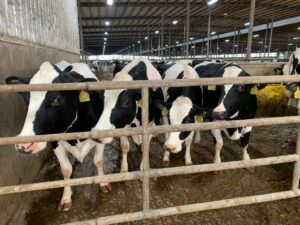 important to improve accuracy in research projects and improve judicious use of antimicrobials in commercial dairy herds. Therefore, the objective of the study was to assess differences in productive and reproductive performance, and survival associated with vaginal discharge characteristics and fever in postpartum dairy cows located in the western and southern states of the United States.
Study population and outcomes assessed
- Data from 3 experiments conducted in 9 dairies were used in this study. Vaginal discharge was evaluated twice within 12 days in milk (DIM) and scored on a 5-point scale. The highest score observed for each cow was used for group assignment (VD group) as follows: VD 1/2 (n = 1,174) = clear mucus/lochia with or without flecks of pus; VD 3 (n = 1,802) = mucopurulent with <50% pus; VD 4 (n = 1,643) = mucopurulent with ≥50% of pus or non-fetid reddish/brownish mucous, n = 1,643; VD 5 = fetid, watery, and reddish/brownish, n = 1,800.
- Rectal temperature was assessed in a subset of VD 5 cows and subsequently divided into Fever (rectal temperature ≥39.5°C [103.1°F]; n = 334) and NoFever (n = 558) groups.
- Resumption of ovarian cyclicity, risk of receiving at least one service, pregnancy at first service, pregnancy by 300 DIM, total milk production within 300 DIM, and removal from the herd within 300 DIM were performance indicators assessed in the project.
Results
- A smaller proportion of cows with VD 5 (67.6%) resumed ovarian cyclicity compared with VD 1/2 (76.2%) and VD 4 (72.9%) cows; however, a similar proportion of VD5 and VD 3 (72.6%) cows resumed ovarian cyclicity.
- A smaller proportion of VD 5 (85.8%) cows received at least one service compared with VD 1/2 (91.5%), VD 3 (91.0%), or VD 4 (91.6%) cows.
- No differences in pregnancy at first service according to VD; however, fewer cows with VD 5 (64.4%) were pregnant at 300 DIM than cows with VD 1/2 (76.5%), VD 3 (76.2%), or VD 4 (74.7%).
- A greater proportion of VD 5 cows were removed from the herd within 300 DIM compared with the other VD groups.
- There was 760 kg (1,676 pounds) less milk production within 300 DIM for VD 5 compared with VD 2, VD 3, and VD 4, whereas VD 2, VD 3, and VD 4 had similar milk production.
- No associations between fever at diagnosis of VD 5 and reproductive performance or milk production were observed; however, a greater proportion of VD 5 cows without fever (29.2%) were removed from the herd by 300 DIM compared with VD 5 cows with fever (20.9%).
In conclusion, differences in productive and reproductive performance, and removal of the herd were restricted to fetid, watery, and reddish/brownish vaginal discharge, which was independent of fever.
Access the paper at:
https://www.sciencedirect.com/science/article/pii/S0022030224006374?via%3Dihub
Combining reproductive outcomes predictors and automated estrus alerts recorded during the voluntary waiting period identified subgroups of cows with different reproductive performance potential
C. Rial and J.O. Giordano
Reproductive performance is crucial for the profitability of dairy farms because it directly impacts milk production efficiency, herd replacement rates, and production costs. This study aimed to compare reproductive performance in dairy cows by grouping them based on prepartum predictors, automated estrous alerts (AEA) during the voluntary waiting period (VWP), and a combination of both factors. The objective was to determine which grouping method most effectively identifies cows with significant differences in reproductive outcomes, including insemination at detected estrus (AIE), pregnancies per artificial insemination (P/AI), and pregnancy by 150 days in milk (DIM) (P150).
Study data
Data from this study were collected from a commercial farm in Minnesota from May 2020 to November 2021.
- The study involved 886 lactating Holstein cows, collecting data from 21 days before calving to 49 DIM.
- Predictors analyzed included calving season, calving-related events, genomic daughter pregnancy rate (gDPR), days in the close-up pen, health disorders, rumination time, and milk yield (MY) by 49 DIM.
- Cows were grouped into risk factor (RF) categories based on high MY, low gDPR, or presence of health disorders (yes=RF; or no=NoRF). Additionally, cows were categorized based on estrous detection during the VWP (E-VWP, had estrus detected; or NE-VWP, did not have estrus detected).
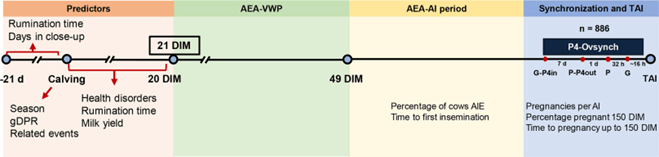
Figure 1. (Rial and Giordano, 2024)
Results
- The NoRF group showed higher AIE (76.9%), P/AI (53.1%), and P150 (84.5%) compared with the RF group (AIE: 64.5%, P/AI: 34.9%, P150: 72.9%).
- The E-VWP group had better reproductive outcomes (AIE: 86.8%, P/AI: 44.8%, P150: 82.3%) than the NE-VWP group (AIE: 50.0%, P/AI: 38.9%, P150: 72.1%).
- When combining both factors, the E-NoRF group (estrus detected and no risk factors) had the highest reproductive performance (AIE: 91.3%, P/AI: 58.7%, P150: 88.5%), while the NE-RF group (no estrus detected and risk factors) had the lowest (AIE: 47.3%, P/AI: 35.8%, P150: 69.5%).
Researchers concluded that integrating AEA during the VWP with prepartum and postpartum predictors significantly improves the identification of cows with differing reproductive performance. Specifically, the combination of estrous detection and absence of risk factors (E-NoRF) yields the highest reproductive success rates, while cows with no estrous detection and multiple risk factors (NE-RF) perform the poorest. This combined approach is more effective than using AEA or predictors alone, providing a robust method for predicting and improving reproductive outcomes in dairy cows.
Access the paper at: https://doi.org/10.3168/jds.2023-24309.
Carry-over effects of maternal late-gestation heat stress on granddaughter’s growth and mammary gland development
G.A. Larsen and J. Laporta
Climate change is causing an increase in the number of heat-stress days globally, affecting cattle in all regions. As a result, more cattle are subjected to environmental heat stress, irrespective of age or physiological stage. Pregnant cows (F0) exposed to heat stress during the final trimester of pregnancy have a negative impact on their first-generation daughters (F1), who experience heat stress while still in utero. Maternal exposure to late-gestation heat stress negatively impacts their daughters’ mammary gland development and milk production during their first lactation. This study extends the investigation to assess the effects on the granddaughter’s (F2) whole-body growth and mammary development when maternal (F0) cows are subjected to heat stress during the last 56 days of gestation.
Study data
Data were initially collected in 2020 at a commercial farm in Florida.
- The study involved multiparous F0 (82) cows that either had heat abatement (shade, fans, and water soakers) or no active cooling (shade only) during a subtropical summer.
- The F1 daughters, born to heat-stressed (HTF1) or cooled (CLF1) cows, were raised under identical conditions until their first calving.
- The F2 granddaughters, born to HTF1 (HTF2) or CLF1 (CLF2) cows, were monitored until 70 days of age.
- Measurements included dry matter intake (DMI), body weight, hip height, wither height, chest girth, head circumference, and mammary gland metrics. Average daily gain (ADG) was calculated for the pre-weaned period (0-49 days).
- At days 21, 49, and 70 of age, a mammary ultrasound was performed on the rear quarters to quantify parenchyma (PAR) and mammary gland fat pad mass (FP) areas, and biopsies were performed to assess gland development and cellular characteristics (epithelial structures, H&E staining; cells positive for estrogen receptor α subunit, Erα; cell proliferation, Ki67; and apoptosis, TUNEL).
Results
- Growth parameters from birth to 49 days, including distances between teats and teat length, were similar between CLF2 and HTF2.
- By day 70, CLF2 tended to have a greater average PAR in the mammary glands compared with HTF2.
- The left FP was smaller in HTF2, although the average FP size was not significantly different between groups.
- Mammary epithelial structures in HTF2 were significantly smaller, with a reduced percentage of proliferating cells and increased apoptotic cells, especially in the stromal compartment.
- HTF2 heifers showed a lower percentage of ERα positive cells compared with CLF2.
In conclusion, despite similar growth rates and DMI between HTF2 and CLF2 heifers during the pre-weaning phase, HTF2 heifers exhibited smaller mammary PAR areas, fewer epithelial structures, reduced cell turnover, and lower ERα expression. These early developmental changes in the mammary gland microstructure and cellular dynamics may contribute to the observed reduction in lactation performance in HTF2 heifers at maturity compared with their CLF2 counterparts.
Access the paper at: https://doi.org/10.3168/jds.2024-24678
Featured Column
Genomics enables faster genetic gains
Do you remember the advertising slogan for Virgina Slims cigarettes? “You’ve Come A Long Way, Baby!” While this slogan references the 1960s’ U.S. civil rights movement, it could also refer to dairy cattle’s genetic progress since incorporating genomics.
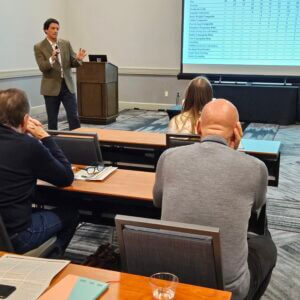 “Genomics has transformed dairy cattle breeding – enabling faster genetic gains,” stated Francisco Peñagaricano, an assistant professor in the University of Wisconsin-Madison department of animal and dairy sciences, during the 2023 Dairy Cattle Reproduction Council (DCRC) Annual Meeting. Historically, dairy producers and genetics companies focused on production traits. With the advancement of genomics, fitness traits and efficiency have become integral components of the genetics equation. Who would have thought this was possible when the use of artificial insemination started in the 1930s? We’ve come a long way, baby!
To set the groundwork of his genomics discussion, Peñagaricano explained that dairy cattle selection programs aim to improve the dairy industry’s profitability and/or sustainability – by targeting traits that increase revenues or reduce expenses. “Contrary to improvements in nutrition, management or cow comfort, changes achieved through selection are incremental, cumulative, and permanent, which makes genetic improvement a very cost-effective strategy,” he stated. “Genetic selection is a very powerful tool for achieving lasting gains in dairy cattle performance.” For example, the current dairy cow produces more than twice as much milk as the dairy cow of 60 years ago. More than half of that improvement is due to genetic selection.
Enhancing health traits
Peñagaricano’s DCRC Annual Meeting presentation focused on using genomics to improve dairy cattle health and fertility. Cow health directly influences dairy farm profitability. Health events generate numerous costs – from health treatments to dumped milk to labor. Add this to reduced income due to decreased milk production.
“Genetic improvement of cow health and welfare is of paramount importance for the dairy industry worldwide,” Peñagaricano remarked. In the past, most breeding programs focused on indirect measures of cow health and fitness, such as length of productive life or somatic cell count as an indicator of udder health. Admittedly, genetic evaluations for somatic cell score were developed to facilitate indirect selection for mastitis resistance. “However, direct selection for health traits is more effective than indirect selection using indicator traits,” he noted. Genomic technology allows us to use direct selection of traits.
Due to the advancement of genomics, the U.S. dairy industry now offers genetic evaluations for six health traits – milk fever, retained placenta, metritis, displaced abomasum, ketosis, and clinical mastitis. “These six health traits are considered the most common and most costly health events impacting U.S. dairy herds,” said Peñagaricano.
Fostering improved fertility
From an economic perspective, reproductive efficiency (fertility) is an important dairy cattle trait. “Reproductive inefficiency results in increased calving intervals, increased involuntary culling rates, decreased milk production, and delayed genetic progress,” Peñagaricano explained. All of these yield significant economic losses.
“Genetic selection for improved cow fertility is a high priority worldwide, Peñagaricano stated. In the United States, three female fertility traits are routinely evaluated. These include heifer conception rate (HCR), cow conception rate (CCR), and daughter pregnancy rate (DPR). Traits HCR and CCR reflect a heifer or cow’s genetic ability to conceive and are defined as the percentages of inseminated heifers or cows that become pregnant at each service.
DPR, the primary trait for improving cow fertility, reflects a cow’s genetic ability to conceive sooner after calving. It is defined as the percentage of nonpregnant cows that become pregnant during a given 21-day period. “An increase of 1% in DPR corresponds to a decrease of approximately four days open,” he noted.
Genomics: A ‘revolution’
For a little background, Peñagaricano described genomic selection as selection decisions based on genomic-estimated breeding values. “These genomic breeding values are calculated using genetic markers across the entire genome,” he explained.
“Genomic technology has ‘revolutionized’ dairy cattle breeding – enabling more rapid genetic progress,” Peñagaricano continued. Genetic progress has been most profound for low heritable traits, such as cow health and fertility. “Genomic selection in dairy cattle has doubled the annual rates of genetic gain for production traits. But even more impressive are the gains realized in fitness traits, with threefold to fourfold improvement in female fertility, udder health, and productive life.”
Use Economic Selection Index
With no reservation at all, Peñagaricano said that the best dairy cattle selection tool is the Economic Selection Index, which incorporates several production (e.g., milk yield and milk composition) and functional traits (e.g., fertility, health, and longevity) into a single value. All traits included in the Economic Selection Index directly impact dairy farm profitability.
For this index, individual traits are weighted based on relevant genetic information, such as heritabilities and genetic correlations, and their economic importance. Currently, the Council on Dairy Cattle Breeding reports four different economic selection indices – Lifetime Net Merit (NM$), Cheese Merit (CM$), Fluid Merit (FM$), and Grazing Merit (GM$). These indices are updated periodically to include new traits and reflect price trends.
Genomic testing leads to informed decisions
Peñagaricano is a strong proponent of genomic testing. “It allows farmers to make accurate selection (culling) decisions at an early age,” he commented. “The identification of genetically inferior heifer calves allows early culling of these animals. This significantly reduces the cost of rearing replacements.” Also, Peñagaricano explained that genetically inferior heifers can be inseminated with beef semen to produce high-value crossbred beef calves.
“When heifers with superior genetics are identified, they can be bred to sexed semen of high genetic value or used in embryo and/or in vitro fertilization programs to rapidly propagate these animals and generate superior replacements,” Peñagaricano remarked.
The University of Wisconsin-Madison assistant professor noted that genotyping replacement heifers has benefits beyond proper selection and mating decisions. Genotyping also provides parentage verification, control of inbreeding, and avoiding the spread of genetic disorders. “Arguably, these benefits add value to genomic testing,” Peñagaricano concluded.
To view Peñagaricano’s DCRC Annual Meeting presentation, log into the DCRC Member Center. Then, click on the 2023 Annual Meeting Recordings icon.
Featured Member
Editor’s Note: For each issue, DCRC interviews a member to learn more about his/her career, involvement with DCRC and thoughts about dairy cattle and reproduction.
Benjamin “Ben” Voelz
STgenetics
DCRC member since 2014
 Who’s the person behind this year’s Dairy Cattle Reproduction Council Annual Meeting program? It’s Benjamin “Ben” Voelz, the technical services team manager for STgenetics, who also serves as the 2024 DCRC Annual Meeting Program Committee chair. Last year, he was the DCRC Annual Meeting Program Committee vice chair, being responsible for the Poster Session.
Volez, along with his team, supports the STgenetics sales staff in the field – working with prospective and current client dairy farms across the United States. The team primarily focuses on genetics, reproduction, breeding strategies and heifer inventory management. Additionally, they provide support via on-farm artificial insemination (AI), maternity and parlor training.
In describing his employer, Voelz quipped that STgenetics is “not just a bull stud.” “STgenetics is a technology company that happens to be a bull stud,” he remarked.
STgenetics abides by its mission statement to make the world greener, more sustainable and profitable. By improving herd genetics through science and technology, STgenetics leaders believe that the best way to predict the future is to create it, while feeding the world with the company’s passion for the beef and dairy industries. The STgenetics Integrated Approach to management combines cutting edge genetics, innovation-driven programs and gender-sorted semen to aid farmers in improving cattle performance to feed the world while reducing their carbon footprint.
Voelz was born and raised on his parents’ dairy in northeastern Wisconsin. That upbringing ignited his passion and desire to pursue a dairy-related career. He attended the University of Wisconsin-River Falls, where he majored in dairy science and minored in agricultural business. Voelz earned a master’s degree in agriculture with a focus on reproductive physiology from Mississippi State University and a PhD in animal science with a focus on reproductive physiology from Kansas State University. He has worked in the dairy AI and genetics industry for the past seven years, with the last 3.5 years at STgenetics – working in technical services.
At a young age, Voelz became fascinated with dairy cattle reproduction. However, it wasn’t until he took reproduction classes at UW-River Falls that his fascination blossomed. “This passion only grew deeper while pursuing my graduate degrees,” he stated. “My real interest now revolves around helping dairy producers improve their reproductive efficiency and maximize the value of their breeding protocols through strategic breeding strategies using sexed semen and beef semen.”
By being a DCRC member, Voelz has learned new strategies for estrous synchronization and resynchronization, and uses DCRC as the “Gold Standard” for estrous synchronization recommendations. “Also, I have learned a great deal about the importance of transition health on the impact of reproductive efficiencies.”
Regarding dairy cattle reproductive challenges, Voelz feels the dairy industry has improved reproductive performance immensely over the past 30 years. “Using technologies like estrous synchronization, activity monitoring systems and gender-sorted semen have fostered these tremendous strides,” he said. “I think a challenge the industry will face is to find ways to incorporate new technologies into our reproductive strategies to continue to see improved reproduction performance.”
Webinar
July 11 DCRC webinar features dairy cattle monitoring technologies
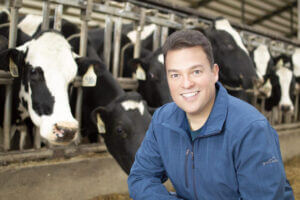 Register for the Dairy Cattle Reproduction Council’s (DCRC) next webinar – Use of monitoring technologies to improve reproductive performance and health in U.S. dairies – set for July 11, starting at 2 p.m. Central time (Chicago time). Glaucio Lopes, Merck Animal Health associate director, scientific sales affairs – dairy monitoring, will lead the free, one-hour webinar.
During this webinar, attendees will learn how the use of monitoring technologies has helped dairies in the United States improve their reproduction management processes – driving an increase in performance. This increased performance leads to a more profitable and sustainable environment. By pairing university research data with real-life dairy examples, Lopes will provide a solid base for this discussion. Additionally, he will share trials from Cornell University, University of Florida-Gainesville and University of Wisconsin-Madison that have answered questions related to the inclusion of these technologies in large-scale dairy operations. Going beyond reproductive efficiency, Lopes will describe how the use of these technologies can help dairy producers and their veterinarians make more informed decisions about overall management – leading to improved cow health and productivity.
Go to: https://bit.ly/DCRCJuly11Web to register for this DCRC webinar. If you are a DCRC member and cannot attend the live program, you may access the webinar at www.dcrcouncil.org after July 24.
A past DCRC president, Lopes received his Doctor of Veterinary Medicine degree from the Universidade Federal Fluminense in Brazil and master’s degree in dairy science and executive master’s degree in business and administration from the University of Wisconsin-Madison. After working with genetics companies in dairy management consulting and people development roles, and directing sales for dairy management software in Latin America, Lopes joined Merck Animal Health where he leads the Dairy Monitoring Customer Success Team.
Veterinarians may earn one Registry of Approved Continuing Education (RACE) credit for attending this DCRC webinar. To learn more about this opportunity, contact JoDee Sattler at: jodee@dcrcouncil.org.
On Aug. 22, Rafael Bisinotto, University of Florida assistant professor, will present “Using omics data to better understand uterine microbial ecology and mitigate the impact of metritis” in Portuguese, starting at 1 p.m. Central time (U.S./Canada). Read more about this webinar in the August DCRC newsletter.
For more information about DCRC’s webinars, e-mail Raphael Saraiva, DCRC Education Committee chair, at: raphael.saraiva@stgen.com or e-mail DCRC at: jodee@dcrcouncil.org.
Industry Calendar
- Four-State Dairy Nutrition and Management Conference, June 5-6, Dubuque, Iowa
- American Dairy Science Association Annual Meeting, June 16-19, West Palm Beach, Florida
- Gopher Dairy Camp, June 20-22, St. Paul, Minnesota
- National Holstein Convention, June 24-27, Salt Lake City, Utah
- Dairy Cattle Reproduction Council Webinar, July 11
- Council on Dairy Cattle Breeding Triannual Evaluation, August 13
- National Mastitis Council Regional Meeting, August 12-14, Ghent, Belgium
- American Association of Bovine Practitioners Annual Conference, September 12-14, Columbus, Ohio
- World Dairy Expo, October 1-4, Madison, Wisconsin
- Dairy Cattle Reproduction Council Annual Meeting, November 12-14, Arlington, Texas
- Council on Dairy Cattle Breeding Triannual Evaluation, December 3
- National Mastitis Council Annual Meeting, January 27-30, Charlotte, North Carolina
- World Ag Expo, February 11-13, Tulare, California
- Central Plains Dairy Expo, March 25-27, Sioux Falls, South Dakota
