
Newsletter – 2025 – October
President's Message
 Dear DCRC Members,
As we move into the final quarter of the year, I’m pleased to share that the program for our upcoming DCRC Annual Meeting is complete and can be accessed on our website. This year’s annual meeting is shaping up to be one of our most engaging yet. The speaker lineup includes a diverse group of experts who will bring fresh insights into reproductive management, emerging technologies, and practical strategies for improving herd performance. Whether you’re a seasoned attendee or joining us for the first time, this year’s sessions promise to deliver exceptional value.
Also, we are introducing a new session to our conference – the Mid-manager Workshop. The workshop, scheduled for early Tuesday afternoon, will be delivered in Spanish by DCRC partner-sponsoring companies in conjunction with a University of Wisconsin dairy expert. The goal of this workshop is to bring current information to mid-managers on topics such as how calfhood events can impair fertility in heifers, sponsored by SCCL/Genex; the effect of fresh cow health on subsequent fertility of cows, sponsored by Zoetis; and the adoption of new technologies to manage fertility programs in cows, sponsored by Merck.
On behalf of the DCRC leadership, I would like to thank the sponsors for the workshop. Your support is highly appreciated! I also would like to extend my gratitude to JP Martin (program chair), Augusto Madureira (DCRC director) and JoDee Sattler (DCRC staff) for putting together this workshop. Registration for the annual meeting and for the workshop is open on our website. If you are interested, hurry up! We have limited spots available for the workshop session and it is on a first-come, first-served basis!
We will also be offering a local dairy farm tour this year! For those interested, the tour will leave at 7:30 a.m. and will visit three proactive Wisconsin dairies. The tour concludes with a bourbon tour and tasting, and good networking time for tour participants.
Last month, I attended the American Association of Bovine Practitioners Annual Conference in Omaha, Neb. A highlight from the conference was the growing emphasis on precision reproductive technologies and their role in improving fertility outcomes in both dairy and beef herds. Topics such as beef-on-dairy integration and emerging threats like the screwworm fly situation at the Mexico-U.S. border sparked meaningful conversations among attendees. It’s clear that new technologies and innovations to improve animal health and fertility are accelerating; DCRC is proud to be part of that momentum.
Talking about beef-on-dairy, on the industry front, we continue to see strong momentum in the beef-on-dairy cattle market. Demand remains bullish, driven by packer interest and feedlot performance data that favor these animals for their growth efficiency and carcass quality. This trend is creating new opportunities for dairy producers to diversify revenue streams while contributing to a more integrated beef supply chain. It’s a development worth watching closely and we’ll be discussing its implications during our meeting. Having a highly fertile herd helps producers execute beef-on-dairy strategies more efficiently.
Meanwhile, we’re keeping a close eye on the screwworm fly situation along the U.S.–Mexico border. U.S. Department of Agriculture and Animal and Plant Heath Inspection Service teams are actively monitoring and responding to recent detections. While containment efforts are progressing, vigilance remains critical. The potential impact on livestock health and reproduction underscores the importance of coordinated surveillance and rapid response. We encourage producers in affected regions to stay informed and follow guidance from local animal health authorities.
As we move toward the final stretch of this year’s DCRC Annual Meeting, this is my final written communication to you as DCRC president. It has been an honor serving as your president over the last year and being involved in several roles over the last seven years. I look forward to interacting with you in Middleton, Wis., Nov. 11-13, as we celebrate another successful year. If you are a dairy producer or a private practice veterinarian, make sure and check out the $200 travel stipend we offer. There are only 10 stipends available and they are awarded on a first-come, first-served basis. If you are interested, contact JoDee Sattler (jodee@dcrcouncil.org).
Warm regards,
Ralph Bruno
President, Dairy Cattle Reproduction Council
Research Summaries
Early postpartum estrous characteristics: Unveiling their predictive potential for fertility in dairy cows
R.C. Chebel, A. Mirzaei, H. Yu, G. Lopes Jr., and R.S. Bisinotto
The objectives of the study were to evaluate the associations between early postpartum estrous characteristics (EPEC; i.e., occurrence of estrus, number of estruses, days in milk [DIM] at estrus, duration, rumination nadir, activity peak, heat index) and fertility. Moreover, the associations between individual (i.e., calving problems, postpartum diseases, milk production) and environmental (i.e., temperature-humidity index [THI] pre and postpartum) risk factors, and EPEC within the first 41 DIM were evaluated.
Study population and outcomes assessed
- The study was conducted using data from 4,578 Holstein cows across 3 commercial dairy herds.
- Data regarding calving characteristics, postpartum health, milk yield, EPEC (estrous events, duration, rumination nadir, activity peak, and heat index), and the environment were collected.
- Reproductive outcomes of interest included pregnancy 77 ±14 days after the first service, fertility class (high fertility [HFERT] = pregnant to first service; low fertility [LFERT] = nonpregnant after the first 3 services), and hazard of pregnancy up to 250 DIM.
- Using a training dataset, an algorithm that was applied to the training and testing datasets to classify cows into bottom, moderate, and top fertility was developed to compare the reproductive performance of cows.
Results
- Overall, 38% of cows were pregnant 77 ±14 days after first service, with a cumulative pregnancy of 67% by the third service.
- Cows with at least 1 estrous event within 41 DIM had greater odds of pregnancy to the first service (0 = referent, 1 = 1.20 [95% confidence interval {CI} = 1.01–1.44], ≥2 = 1.16 [95% CI = 0.89–1.52]) and of a cow being HFERT (0 = referent, 1 = 1.26 [95% CI = 1.00–1.59], ≥2 = 1.09 [95% CI = 0.78–1.54]). However, more than 1 estrous event did not further improve fertility outcomes. The positive association between estrus within 41 DIM and hazard of pregnancy was reflected in shorter days open (0 = 115.0 days, 1 = 94.0 days, ≥2 = 89.0 days).
- Lower rumination nadir was associated with increased odds of pregnancy to the first service and of a cow being HFERT. Similarly, cows in the lowest tertile of rumination nadir had the greatest hazard of pregnancy by 250 DIM.
- Cows in the testing dataset classified as bottom and top 25% percentiles of fertility had a 23-day difference in median days open (127 days vs. 104 days) and a 5.3-percentage point difference in censoring by 250 DIM (28.6% vs. 23.3%).
In conclusion, this study demonstrates that EPEC are valuable indicators of reproductive potential in dairy cows. Integrating health, genetic, and environmental data with EPEC improves the prediction of fertility outcomes, providing opportunities to optimize reproductive management and efficiency in dairy herds. Finally, results of these algorithms demonstrate the potential of EPEC to predict long-term reproductive performance of lactating Holstein cows.
Access the paper at Early postpartum estrous characteristics: Unveiling their predictive potential for fertility in dairy cows – ScienceDirect
Predicting sire fertility in artificial insemination of dairy cows by the ability of spermatozoa to bind to oviduct cell aggregates
Mateus A. Silva, Paula R. Cortat, Carlos E.C. Consentini, Sâmara C.C. Pinto, Eneiva C.C. Celeghini, José O. Carvalho, Leonardo F. Melo, Milo Wiltbank, and Roberto Sartori
The objective of this study was to evaluate the relationship between sperm morphofunctional characteristics, sperm binding to oviduct epithelial cell (OEC) aggregates, and field fertility (pregnancy/artificial insemination [P/AI] results) in dairy bulls. The authors hypothesized that sperm morphofunctional characteristics would be similar between low-fertility (LF) and high-fertility (HF) sires; that, due to reduced ability to bind to oviduct cells in vitro, LF bulls would have fewer sperm bound to OEC aggregates over time; and that there would be a correlation between the number of sperm bound to OEC aggregates over time and P/AI.
Study population and outcomes assessed
- Fertility data of 7 Holstein bulls were obtained from 1,833 AI performed during a 2-year period in a commercial dairy herd in São Pedro, São Paulo, Brazil.
- Sires were classified into higher fertility (HF; 35.0% pregnancy rate [362/1,034], n=3) and lower fertility (LF; 21.4% pregnancy rate [171/799], n=4) groups.
- Semen quality was assessed through computer-assisted sperm analysis (CASA) for motility and flow cytometry for membrane integrity, mitochondrial potential, lipid peroxidation, and fluidity.
- Sperm binding to OEC aggregates was evaluated using isthmic oviduct tissue from slaughterhouse specimens, co-incubated with motile sperm, and assessed at 0.5, 12, 24, and 36 hours.
Results
The morphofunctional sperm analyses did not reveal relevant differences between HF and LF sires, with no major differences in motility or other flow cytometry parameters found between HF and LF sires, except for a higher straight-line velocity in HF bulls.
- The number of sperm bound per millimeter of OEC aggregates was higher in HF bulls at all time points.
- Sperm binding capacity at 36 hours was strongly correlated with field fertility (r = 0.89).
In conclusion, these findings suggest that reduced sperm binding to oviduct cells may contribute to lower fertility in bulls and highlight the potential of the OEC binding assay as an early predictor of male fertility. Further research is ongoing to refine the assay and explore additional physiological differences between high- and low-fertility bulls.
Access the paper at: Predicting sire fertility in artificial insemination of dairy cows by the ability of spermatozoa to bind to oviduct cell aggregates – ScienceDirect
Associations of cytological endometritis with insulin resistance and gene expression in adipose tissue in transition dairy cows
P Karis, H. Jaakson, K. Ling, G. Opsomer, L. Siimon, E. Reimann, P. Pärn, J.J. Gross, M. Henno, J. Kurykin, M Valdmann, M. Ots, and A. Waldmann
Cytological endometritis (CYTO), characterized by an elevated number of polymorphonuclear neutrophils in the endometrium, negatively affects reproductive outcomes in dairy cows. In this study, the associations between insulin resistance (IR) during the transition period and the occurrence of CYTO were assessed.
Study population and outcomes assessed
- Insulin sensitivity and adipose tissue gene expression on day −21 and day 21, and a selection of blood metabolites weekly from day −21 to day 42 relative to calving of 39 Holstein dairy cows were measured. Study groups were formed based on the CYTO status on day 42.
Results
- Research findings indicate that cows with CYTO had a greater insulin response to a glucose infusion prepartum, suggesting a link between prepartum IR and the development of CYTO.
- Postpartum, CYTO cows showed lower insulin and higher nonesterified fatty acids concentrations in plasma.
- Additionally, CYTO cows showed altered gene expression in subcutaneous adipose tissue, with increased mRNA levels of hormone-sensitive lipase (LIPE) and insulin receptor (INSR), and a tendency for higher glucose transporter 4 (GLUT4) protein levels.
In conclusion, these results suggest that metabolic stress and IR are interconnected, contributing to the development of CYTO. The study underscores the importance of managing metabolic health before calving to prevent CYTO and improve reproductive performance in dairy cows.
Access the paper at https://www.sciencedirect.com/science/article/pii/S0022030225006319
Featured Column
Managing uterine health: Today’s options, tomorrow’s possibilities
“Like the surface of other dairy cow organs that contact the outside world, the uterus has a normal population of bacteria – its ‘microbiota’,” shared Stephen LeBlanc, University of Guelph professor, at the 2024 Dairy Cattle Reproduction Council Annual Meeting. Most dairy cows have potential disease-causing bacteria in their reproductive tract in low abundance. A healthy microbiota is a diverse set of many bacteria. Cows develop uterine infection and disease when the pathogens overgrow and become dominant.
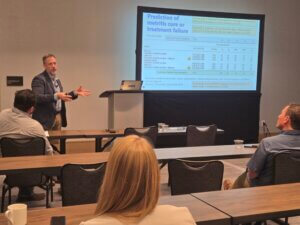
Stephen LeBlanc, University of Guelph
While contamination of the reproductive tract during and after calving matters (i.e., hygiene during calving assistance and experiencing a retained placenta), the cow’s immune and inflammatory response matters more. “Cows need to have a rapid, robust, but well-regulated inflammatory response in the uterus during and immediately after calving to detach the placenta, keep bacterial pathogens in check, and start uterine repair,” LeBlanc stated. Following calving, the goal is to achieve “Goldilocks inflammation” – not too little, not too much, but just right.
Metritis is the clinical disease that occurs when bacterial pathogens gain the “upper hand” against the cow’s immune system. “Literally, metritis stinks,” LeBlanc quipped. Why? The anaerobic bacteria produce the characteristic fetid or foul smell of the discharge. Also, metritis “stinks” because it causes long-term impairment of milk yield and fertility.
Traditionally, metritis was defined as uterine infection and inflammation with fetid vaginal discharge and a fever (temperature >103.5 F/39.5 C). “That case definition is associated with reduced pregnancy rate, but fetid discharge – even without a fever – and associated with reduced milk yield for several months after calving,” LeBlanc explained. Although fever is one of the factors associated with failure to cure metritis (even with antibiotic therapy), the weight of recent evidence is that the key criterion to diagnose metritis is fetid vaginal discharge – with or without a fever (Figueiredo et al., 2024).”
Metritis treatment is generally worthwhile
Because metritis is caused by bacteria, LeBlanc said that treatment with antibiotics is “rational.” However, several studies show that even with treatment, around 25 to 30% of cows still had fetid discharge about one week after the end of antibiotic therapy (Chenault et al., 2004; MacLaughlin et al., 2012; Lima et al., 2014).
“Not surprisingly, this treatment failure is associated with worse future performance,” LeBlanc noted. In the few metritis studies with an untreated control group, 50 to 60% of those cows self-cured based on clinical signs. However, it’s critical to consider future milk production, pregnancy, and culling.
A large, comprehensive University of Florida study with an untreated control group provided good data to show that metritis costs approximately $500 per case, driven by losses in full-lactation milk production and pregnancy, and consequent culling of cows open at the end of lactation (Pérez-Báez et al., 2021). However, on-label treatment of metritis with an antibiotic (ceftiofur) reduced losses due to non-pregnancy and culling by 10 percentage points. This strategy cut disease cost to $250 per case (Silva et al., JDS 2021). “Accordingly, the best practice today is to find and treat cows with fetid discharge with approved antibiotic therapy,” LeBlanc stated.
Not all metritis cases need treatment
The same researchers collected additional data from about 150 treated and 150 untreated cows with metritis to look for subgroups of cows that might perform well if untreated. They identified two promising variables: days in milk (DIM) at metritis diagnosis and blood haptoglobin concentration (Machado et al., 2020). Haptoglobin is a marker of inflammation. Cows with lower levels at metritis diagnosis might be candidates for a conservative treatment, but the test requires being sent out to a laboratory. “Thus, this practice is not yet practical,” LeBlanc commented.
“Cows diagnosed with metritis >8 DIM might also be candidates for no antibiotic treatment – based on milk and reproductive performance in the control group, which was similar to cows without metritis,” LeBlanc remarked. “However, this needs to be confirmed via additional studies before widespread implementation.”
LeBlanc’s research team at the University of Guelph conducted a randomized controlled treatment trial in 200 cows with metritis, initially treating with ceftiofur or the anti-inflammatory drug ketoprofen for three days (Paiano et al., 2024). (Ketoprofen is approved in Canada with zero milk discard, but it is not approved for milking cows in the United States.) The team assessed fever and clinical illness on the fourth day and continued ceftiofur or started it in cows that initially received ketoprofen.
“There were no differences between cows with metritis with either treatment or with cows that did not have metritis in postpartum disease incidence, return to cyclicity, pregnancy at first artificial insemination (AI), or pregnancy rates through lactation,” said LeBlanc. Cows with metritis produced less milk than healthy cows in the first six weeks of lactation, but milk yields in early lactation were similar in cows with metritis with either treatment.
Look at long-term results
“Even if treated, cows with metritis lose milk yield in early lactation, which is not made up through the whole lactation,” LeBlanc commented. Despite studies showing similar pregnancy at first AI between cows with treated metritis and cows without metritis, their pregnancy rates diverge through lactation – such that cows that started the lactation with metritis, despite apparently successful treatment, are less likely to be pregnant at the end (Lima et al., 2019; Pérez-Báez et al., 2021; Silva et al., 2021).”
LeBlanc noted that pregnancy losses are substantial in healthy cows. However, University of Guelph research showed that postpartum uterine disease brings a “double hit.” “Cows are less likely to be pregnant at the earliest detection and more likely to lose their pregnancy after first AI,” he reported. For metritis, specifically, pregnancy losses from day 19 to day 40 were 77% – double that in cows without metritis (Bruinjé et al., 2024).
In the near future, LeBlanc anticipates using more selective metritis treatment protocols that use cow and sensor data to refine which cows receive antibiotic therapy, other therapy, or perhaps no therapy. “For now, I recommend looking for (detecting) metritis and treating cows with fetid discharge in the first week or so after calving.”
References available upon request. Contact JoDee Sattler (jodee@dcrcouncil.org).
Featured Member
Editor’s Note: For each issue, DCRC interviews a member to learn more about his/her career, involvement with DCRC and thoughts about dairy cattle and reproduction.
Paula Molinari
Genex
DCRC member since 2022
It’s no easy task – executing the Dairy Cattle Reproduction Council (DCRC) Annual Meeting Poster Session – but Paula Molinari “raised her hand” to coordinate this year’s poster session. Next year, she’ll serve as the DCRC Annual Meeting program chair.
Molinari’s interest in dairy cattle sprouted during her second year of veterinary school at the University of São Paulo. She gained hands-on experience working in the college’s dairy and nutrition lab. “That experience opened the door to undergraduate research on mammary gland health and an internship with José Santos at the University of Florida (UF),” she explained. In Florida, she worked on transition cow health projects. After finishing vet school, Molinari returned to UF to pursue a PhD in animal molecular and cellular biology under John Bromfield. Her research focused on the effects of heat stress on uterine health in dairy cows.
Three years ago, Molinari launched her dairy career by joining Genex as a dairy account manager and consultant. Her main responsibilities include:
- On-farm consulting: Diagnose reproduction bottlenecks, monitor replacements and protocol compliance, and align sire selection with each dairy’s genetic goals. Support transition cow health and conduct calf audits with actionable standard operating procedures (SOP).
- Data and reporting: Track key performance indicators (KPI), analyze herd data to surface opportunities, and build custom dashboards and reports that guide decisions and reveal market share growth opportunities.
- Training and collaboration: Coach farm teams on protocols and tools, and coordinate with Genex teammates to deliver consistent, results-driven service.
Molinari splits her time between hands-on consulting and data-driven strategy. On farm, she troubleshoots reproduction issues, tracks replacements and protocol compliance, and helps define genetic goals to ensure sire selection and breeding strategy stay aligned with those targets. Also, she supports transition cow health programs and performs calf audits that translate into clear SOPs. On the analytics side, she monitors KPIs, mines herd data to identify opportunity areas, and builds tailored dashboards and reports so teams can act quickly. Beyond that, she helps staff with Genex’s valued-added tools and partners with colleagues to deliver consistent results and uncover market share growth opportunities.
When asked about her interest in dairy cattle reproduction, Molinari said that reproduction sets the trajectory for the entire herd. “The returns on repro and genetics can take time to show, but the choices we make today determine tomorrow’s cows,” she stated. “Reproduction drives performance, genetic progress, animal health, and farms’ profitability and sustainability. With the right plan, reproduction becomes a lever for long-term resilience and animal well-being.”
DCRC ‘raises the bar’
When it comes to DCRC’s influence on dairy cattle reproduction education and improvement, Molinari credits DCRC for “raising the bar” for cattle reproduction. DCRC does this by turning high-quality science into practical, on-farm action. “Through its annual meeting, webinars, and resources, DCRC keeps producers, veterinarians, consultants, and the industry up to date on both sides of the equation – what the latest research is uncovering and what progressive herds are doing day to day. The real value is the mix of farmers, industry, and academia in the same room, so new ideas – from transition management, replacement strategies, activity monitoring systems, diagnostics, and genetic strategies – are discussed through different viewpoints. I regularly use DCRC resources to stay up to date and reference DCRC materials when talking with farm workers.”
Molinari stated that DCRC is a great connector between researchers, industry, and producers. “By bringing everyone into the same room, it turns emerging research into practical conversations about fit and feasibility. The panel sessions, in particular, reveal where promising ideas align or clash, and how different farms go about the same topic – sharing what works and what does not work.”
Additionally, DCRC is a great resource center where Molinari finds materials to take as references to farm staff and producers. “Also, the webinars are great to stay updated on new topics influencing repro, such as the sessions leveraging the use of monitoring systems by Julio Giodano, Cornell University, and Ricardo Chebel, UF, earlier this year. “Language access is also a plus, with some talks offered in Spanish and Portuguese, which helps bring these insights to different teams.”
Mitigating repro challenges
While great strides have been made, Molinari said that dairy cattle repro challenges remain. In her region (southern United States), the biggest reproductive challenge is heat stress. Long, hot seasons, warm temperatures at night, and high temperature-humidity index (THI) in holding pens and close-up barns suppress estrous expression, impair oocyte quality, and increase early embryonic loss, which shows up as lower repro performance from late spring through fall. Plus, heat stress triggers long-lasting effects on heifers that were under heat stress in utero.
“Beyond heat stress, protocol consistency and labor remain persistent hurdles,” Molinari stated. “Turnover and small deviations in timing or technique can quietly damage conception. That’s why regular training and ‘repro refreshers’ are essential so teams understand the why behind the SOPs and execute them consistently.”
Molinari added, “One issue I face more often than I’d like to see is data quality, such as mislabeled or missing events, lagging entries, mixed IDs, and ghost animals. These inaccuracies make troubleshooting harder and delay course corrections.”
In conclusion, Molinari remarked, “Together, these factors highlight the importance of being proactive on heat abatement, investing in a well-trained team executing simple, consistent protocols, and building a culture of accurate, timely data entry to support evidence-based decisions.”
Featured Webinar
DCRC’s Portuguese webinar highlights nutrition’s influence on reproduction
“Nutritional Interventions to Enhance Postpartum Health and Reproduction in Dairy Cows” (Intervenҫões nutricionaies para melhorar a saúde pós-parto e reproduҫão em vacas leiteiras) presented in Portuguese, is the featured topic for the next Dairy Cattle Reproduction Council (DCRC) webinar. The free webinar starts at 1 p.m. Central time (Chicago time) on Oct. 16. Marcos Marcondes, Miner Institute research scientist, will serve as the instructor for this one-hour webinar.
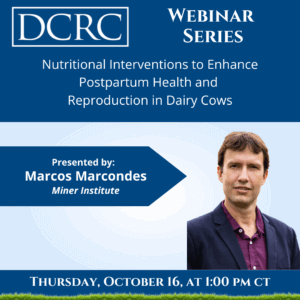 Reproductive success in dairy cows begins with a healthy transition period – when cows face intense metabolic and inflammatory challenges. This webinar will explore how targeted nutritional strategies – especially the use of key feed additives – can improve metabolic health after calving and support timely return to estrus and conception. Marcondes will examine evidence on additives, such as yeast products, trace minerals, fatty acids and chromium, highlighting practical applications that enhance both cow health and reproductive performance.
(O sucesso reprodutivo em vacas leiteiras começa com um período de transição saudável – quando as vacas enfrentam intensos desafios metabólicos e inflamatórios. Este webinar abordará como estratégias nutricionais direcionadas – especialmente o uso de aditivos alimentares – podem melhorar a saúde metabólica após o parto e favorecer o retorno ao estro e à concepção. Dr. Marcondes analisará as evidências sobre aditivos como produtos de levedura, micronutrients, ácidos graxos, cromo, etc., destacando aplicações práticas que potencializam tanto a saúde das vacas quanto o desempenho reprodutivo.)
To register for this webinar, go to: https://bit.ly/DCRC1016. If you are a DCRC member and cannot attend the live program, you may access the webinar recording at www.dcrcouncil.org after Oct. 30.
Marcondes earned his bachelor’s degree, master’s degree and PhD from at the Federal University of Viçosa. Then, he conducted postdoctoral research at the University of Florida. From 2010-2021, he served as a dairy cattle management and nutrition professor at the Federal University of Viçosa. In 2021, he joined the Washington State University faculty as a dairy cattle nutrition professor. Marcondes started employment with the William H Miner Institute as a dairy research scientist last year. At the Miner Institute, he focuses on researching feed evaluation, nutrient requirements and the economics of dairy operations. Also, Marcondes studies additives for mitigating methane production in cattle and the impact of nutrition on the performance and mammary gland development of calves and heifers.
For more information about DCRC’s webinars, e-mail Caio Figueiredo, DCRC Education Committee chair, at: caio.figueiredo@wsu.edu.
Industry Calendar
- Dairy Calf & Heifer Association Webinar, October 9
- American Dairy Science Association Discover Conference, October 13-16, Itasca, Illinois
- Dairy Cattle Reproduction Council Webinar (in Portuguese), October 16
- International Dairy Federation World Dairy Summit, October 20-23, Santiago Chile
- Cornell Nutrition Conference, October 21-23, East Syracuse, New York
- Dairy Calf & Heifer Association Vision & Training Seminar, October 28, Garden City, Kansas
- PDP Business Management & Advanced Finance Workshop, October 29-30, Sun Prairie, Wisconsin
- Dairy Calf & Heifer Association Webinar, November 6
- Joint Annual Meeting of the National Dairy Promotion and Research Board, National Milk Producers Federation and United Dairy Industry Association, November 9-12, Arlington, Texas
- Dairy Cattle Reproduction Council Annual Meeting, November 11-13, Middleton, Wisconsin
- Council on Dairy Cattle Breeding Triannual Evaluation, December 2
- 4th International Precision Dairy Farming Conference, December 3-5, Christchurch, New Zealand
- Dairy Strong Conference, January 14-15, Green Bay, Wisconsin
- NMC Annual Meeting, January 26-29, Birmingham, Alabama
- World Ag Expo, February 10-12, Tulare, California
- Professional Dairy Producers Business Conference, March 4-5, Madison, Wisconsin
- Central Plains Dairy Expo, March 17-19, Sioux Falls, South Dakota
- Dairy Calf & Heifer Association Annual Conference and Trade Show, April 7-9, Tucson, Arizona
- NMC Regional Meeting, June 16-18, Green Bay, Wisconsin
