
Webinars
DCRC 2026 Webinar Series
The Dairy Cattle Reproduction Council scheduled three webinars – July 8 and 29, and Aug. 20. All three webinars start at 2 p.m. Central time (Chicago time). The two webinars being presented in English (July 29 and Aug. 20) each provide one RACE-approved continuing education credit for veterinarians.
July 8 (presented in Portuguese)
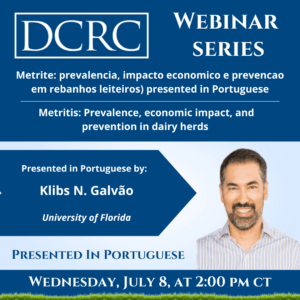 Metritis: Prevalence, economic impact, and prevention in dairy herds (Metrite: prevalencia, impacto economico e prevencao em rebanhos leiteiros) presented in Portuguese)
Klibs N. Galvão, University of Florida
To register for this webinar, go to: https://bit.ly/DCRCWebJuly8.
Metritis is highly prevalent and typically treated with antibiotics. When making antibiotic treatment decisions, consider cow welfare, increased antimicrobial resistance, and the economic impact of not treating the cow. Treatment with antibiotics increases the cure rate; therefore, considering the welfare of cows diagnosed with metritis, the increase in cure rate alone might justify antibiotic treatment. However, metritis has a high self-cure rate. Thus, leaving cows untreated at the time of metritis diagnosis and only treating those that do not self-cure or present worsening of clinical signs might slow the development of antimicrobial resistance. Looking at the economic impact, antibiotic treatment resulted in decreased metritis-related costs, mostly due to reduced milk losses.
Galvão is a professor of food animal reproduction and medicine in the department of large animal clinical sciences at the University of Florida. He completed a residency in dairy production medicine and a master’s degree in preventive veterinary medicine at the University of California-Davis, and then earned a PhD in reproductive physiology at Cornell University. Galvão’s research focuses on uterine immunology and microbiology in health and disease, epidemiological investigation of the risk factors for uterine disease, development of therapeutics for prevention and treatment of uterine disease, and the use of herd simulation models and budget impact analysis to understand how uterine disease and impaired fertility affect the profitability of dairy herds.
July 29
Extended lactations and cow longevity: How long is long enough?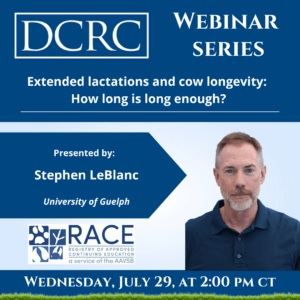
Stephen LeBlanc, University of Guelph
To register for this DCRC webinar, go to: https://bit.ly/DCRCWebJuly29.
There are discussions in the dairy industry about whether it should be an explicit aim to increase longevity. Some assert that retaining cows for more years or extending lactation length contributes to sustainability, because fewer replacement animals would be needed – reducing the environmental costs of these non-productive animals. However, these claims should be considered critically. LeBlanc will outline why longevity is not a measure of animal welfare or profitability, and why we should seek to optimize – not maximize – longevity for each cow and herd.
LeBlanc is a professor in the department of population medicine at the University of Guelph and director of Dairy at Guelph – The Centre for Dairy Research and Innovation. He received a bachelor’s degree in animal science from McGill University in 1992 and a Doctor of Veterinary Medicine degree in 1997 and DVSc in 2001 from the University of Guelph. His research focuses on dairy cow metabolic and reproductive health and management, precision technologies and antimicrobial stewardship. With graduate students and collaborators, this work has resulted in more than 200 peer-reviewed papers.
August 20
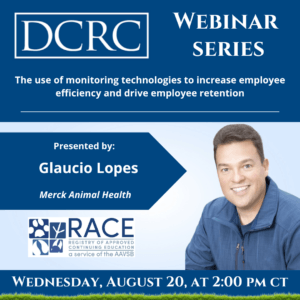 The use of monitoring technologies to increase employee efficiency and drive employee retention
Glaucio Lopes, Merck Animal Health
To register for this DCRC webinar, go to: https://bit.ly/DCRCWebAug20.
During this presentation, Lopes will discuss how monitoring technologies have been used in large, progressive dairy operations in the United States. Also, he will describe the process of having different stakeholders at the dairy to embrace and use technology, and the challenges they face during implementation. With farm performance data, attendees will learn how the use of technology is paramount to increasing efficiency and driving employee satisfaction and retention. Furthermore, the presentation will include a discussion of the benefits of using monitoring technologies and how the adoption and implementation of these technologies are helping owners increase their bottom line – driving efficiencies with the veterinarian, animals, and animal handlers.
A native of Brazil, Lopes received his Doctor of Veterinary Medicine degree from the Universidade Federal Fluminense in Niterói, Rio de Janeiro. Upon graduation, he practiced in small commercial dairy farms and beef operations as a veterinarian before joining Ricardo Chebel at the University of California-Davis. In California, Lopes worked in several research studies focused on reproduction of dairy cows and heifers; calf management, growth, and feed additives; and dairy production and health in large dairy farms. In 2011, he completed his master’s degree in reproductive physiology from the University of Wisconsin. His research focused on synchronization and resynchronization of ovulation protocols for fixed-time artificial insemination, use of electronic devices for estrous detection, and assessment of accuracy of blood tests for pregnancy diagnosis in dairy cattle.
If you are a DCRC member and cannot attend a live program, you may access the webinar recording at dcrcouncil.org two weeks following the live presentation.
