
Newsletter – 2021 – December
President's message
 From the DCRC President’s Desk
By Matt Utt
Hello DCRC membership! I am honored and looking forward to serving as your president for 2021-2022. My first DCRC Annual Meeting was in 2012. Starting my eighth year of service to DCRC, I ask myself, “Where has the time gone and why have I been so involved with this organization?” Although I believe the content of our annual meeting, webinars and other resources are very good, the opportunity to mix with professionals from academia and allied industry, veterinarians, dairy producers and friends is what makes DCRC and our annual meeting so special. If you would like to become more involved with leadership in DCRC, there are many opportunities to serve. Please contact a DCRC board member to discuss these opportunities.
The DCRC Annual Meeting last month was a success with more than 130 in-person registered attendees and more than 70 virtual attendees. A diverse lineup of plenary speakers pushed us to think about the dairy industry’s future, along with a variety of breakout sessions that covered many aspects of dairy production. This great combination made for a fantastic program. The excellent meeting would not have been possible without the hard work of Program Chair Ralph Bruno and Program Vice Chair Pablo Pinedo, the DCRC staff, DCRC board, sponsors, and more importantly, the participants. Thank you to those who filled out the surveys at the end of each day. We value your input and want to create a program that you find valuable. Should you have more feedback or suggestions, please reach out to me, the DCRC staff or a board member.
We welcome three new members to the DCRC Board for 2021-2022 and thank outgoing board members Julio Giordano (Cornell University), Luis Mendonca (Merck) and Jeff Stevenson (Kansas State University) for their dedication and service to DCRC. We will miss the warm demeanor and leadership of Jeff Stevenson, a founding member of DCRC, long-tenured secretary/treasurer and annual meeting proceedings editor, as he enters retirement. Thank you, Jeff!
2021-2022 DCRC Board of Directors
President – Matt Utt, Select Sires
Vice President – BJ Jones, Center Hill Veterinary Clinic (new)
Past President – Mike Overton, Zoetis
Secretary/Treasurer – Luciano Caixeta, University of Minnesota (new)
Director – Natalia Martinez-Patino, Zoetis
Director – Eduardo Ribeiro, University of Guelph
Director – Brian Schilling, Schilling Farms LLC (new)
I would like to recognize all of the dairies nominated for the 2021 DCRC Excellence in Dairy Reproduction Awards and especially the Platinum, Gold, Silver and Bronze winners listed below.
Platinum
Emerald Spring Dairy (Darrin Young), Plainview, Minn.
Kliebenstien Farms (Nate and Morgan Kliebenstien), Darlington, Wis.
Scholze Dairy (Theo Scholze), Humbird, Wis.
Red Top Jerseys (Chris Terra), Chowchilla, Calif.
Wessel Farms LLC (David Wessel), Mineral Point, Wis.
Latham Dairy (John Latham, owner, and Mark Winters, manager), Boscobel, Wis.
Gold
Williams Bedrock Bovines (Jeff Williams), Brodhead, Wis.
Brooklyn Rollin Green Dairy (Jim, Jeff and Jamie McNeely), Brooklyn, Wis.
Holmesville Dairy (Travis Holmes), Argyle Wis.
Britannia Dairy (Ben and Kevin Pearson), Flandreau, S.D.
High Noon Dairy (Peter Bouma), Hereford, Texas
Boernview Farms Ltd. (Roger Boersen), Gadshill, Ont., Canada
Silver
Hammink Dairy (Wim Hammink), Bruce, S.D.
Claytop Holsteins (Jeff Paulen), Howard City, Mich.
Sunrise Dairy (Dan Hischke), Suring, Wis.
Verhoef Dairy Farm Inc. (Reinoud and Klaartje Verhoef), Belmont, Ont., Canada
Blue Star Dairy Farms (Brian and Craig Meinholz), DeForest, Wis.
Nosbush Dairy (Brad Nosbush), Fairfax, Minn.
Bronze
Faywillow Farms (Al Ruf and Tim Douglas), Darlington, Wis.
Night Hawk Dairy LLC (Chris Leick), Stratford, Wis.
Davis Family Farms LLC (Jayme and Brad Davis), Darlington, Wis.
Baudhuin’s Grandview Dairy LLC (Karen Baudhuin), Casco, Wis.
Trailside Holsteins (Mike Johnson), Fountain, Minn.
Scheps Dairy (Ken and Dan Scheps), Almena, Wis.
The DCRC Scholar program was founded to promote the participation of graduate students studying dairy, animal or veterinary science, microbiology or a related program, with an area of interest that includes dairy cattle reproduction and fertility. Congratulations to Ali Husnain for being selected as the 2021 DCRC Scholar! Ali, a native of Pakistan, is a PhD student at the University of Florida, studying the role of uterine inflammation on embryo implantation in dairy cows. Ali plans to return to Pakistan to help veterinary students, dairy producers and industry partners. I sincerely hope that Ali will remain a part of our global DCRC community.
Next year, DCRC will partner with the Dairy Tech meeting in Stoneleigh Park, England, which is scheduled for Feb. 2, to increase DCRC’s international exposure. Three presentations focusing on dairy sustainability, profitability and monitoring reproductive performance will be presented by Frank Mitloehner (University of California-Davis), Michael Overton (DCRC past president/Zoetis) and Matt Utt (DCRC president/Select Sires), respectively. Next year will also bring new materials and webinars, so please follow our Facebook page and website.
I wish each of you a happy holiday season and best wishes in 2022. I look forward to seeing you next year in person at the DCRC Annual Meeting in Madison, Wis., Nov. 15-17.
Research Summaries
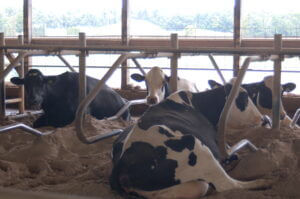 Effect of body condition change and health status during early lactation on performance and survival of Holstein cows
Manríquez, W.W. Thatcher, J.E.P. Santos, R.C. Chebel, K.N. Galvão, G.M. Schuenemann, R.C. Bicalho, R.O. Gilbert, S. Rodriguez-Zas, C.M. Seabury, G.J.M. Rosa, and P. Pinedo
After calving, dairy cows usually have low dry matter intake, which is coupled with an increased nutritional demand to support milk production. This combination triggers mobilization of body reserves of fat and protein, which result in body condition score (BCS) losses. Cows that lose BCS in the postpartum period are more likely to present health problems, which can ultimately affect production, reproduction, and culling dynamics in dairy herds. The objective of this study was to evaluate the effects of different levels of changes in BCS during the postpartum period on fertility, milk production, and survival in Holstein cows considered healthy that presented a reproductive disorder or other health disorders within 40 days in milk (DIM).
Materials and methods
- This was a retrospective cohort study.
- Data were collected from 11,733 Holstein cows from 16 herds.
- Data included lactations started between November 2012 and October 2014.
- All herds housed cows in freestalls or dry lots with shades.
- Cows were enrolled in the study at parturition.
- Cows were evaluated for BCS at 5 + 3 and 40 + 3 DIM .
- Difference in BCS between 40 and 5 DIM was calculated and cows were categorized as:
- EL – excessive loss in BCS (cows that lost more than 0.75 point in BCS)
- ML – moderate loss in BCS (cows that lost 0.5 to 0.25 point in BCS)
- NC – no change in BCS (cows that did not lose BCS)
- GN – gain in BCS (cows that gained BCS)
- Cows were monitored weekly for disease occurrence, reproductive events, and culling.
- Only health events diagnosed within 40 DIM were considered in the analyses.
- Based on health status in the first 40 DIM , cows were classified as:
- HLT – cows with no recorded health disorders
- REPR – cows diagnosed with dystocia, twins, retained placenta, metritis, or clinical endometritis
- OTH – cows diagnosed with other disorders (subclinical ketosis, left displaced abomasum, lameness, clinical mastitis, and respiratory problems)
Results
- Odds of resumption of ovarian cyclicity were greater for GN, NC, and ML than for EL cows.
- Odds of pregnancy at 150 DIM were 1.61 times greater than for EL cows.
- Cows with REP or OTH had smaller odds of resumption of ovarian cyclicity (OR = 0.65, and OR = 0.79, respectively), compared with HLT cows.
- Odds of pregnancy at first artificial insemination were less for REP, compared with HLT cows (OR = 0.70).
- Odds of being diagnosed pregnant by 150 and 305 DIM were less for REP (OR = 0.73, OR = 0.58, respectively), compared with HLT cows.
- Average daily milk yield within the first 90 DIM was greater in EL and ML (39.5 and 38.9 kg/day, respectively), than in NC and GN (37.8 and 36.2 kg/day, respectively).
- Average daily milk yield within the first 90 DIM was lower for REP (37.0 kg/day), compared with OTH and HLT cows (38.7 and 38.6 kg/day, respectively).
In conclusion, change in BCS and health status within the first 40 DIM influenced subsequent reproductive and productive performance, and culling dynamics. Excessive BCS loss and reproductive disorders decreased reproductive performance and survival. The magnitude of BCS change and health status in early-lactation Holstein cows should be considered when evaluating performance and culling dynamics during the lactation.
Access the paper at https://doi.org/10.3168/jds.2020-20091
Estrous activity in lactating cows with divergent genetic merit for fertility traits
C.B. Reed, B. Kuhn-Sherlock, C.R. Burke, and S. Meier
Detection of estrus is paramount for artificial insemination success and reproductive performance. However, adequate estrous detection results are not always achieved in many herds, which contributes to poor reproductive results. Genetic merit for fertility traits has been associated with estrous characteristics and greater submission rates because cattle with great genetic merit for fertility traits have more intense and longer estrous bouts. Thus, the authors’ objective was to determine the effect of genetic merit for fertility traits on estrous expression and estrous cycle duration in grazing dairy cows. A secondary aim was to describe the effect of successive postpartum ovulations on estrous behavior traits.
Materials and methods
- Cows were grazed under a spring-calving system in New Zealand and were milked twice daily.
- First- and second-lactation cows with positive (POS FertBV) and negative (NEG FertBV) genetic merit for fertility were fitted with neck-mounted, activity-monitoring devices (Heatime, SCR Engineers Ltd.).
- POS FertBV: n = 242, n = 188; NEG FertBV: n = 159, n = 87 in lactation 1 and 2, respectively.
- An estrous event was identified when the activity change index exceeded 26 activity units (AU) for 4 hours (h).
- Milk progesterone (measured twice a week for lactation 1 and once a week for lactation 2 cows during the voluntary waiting period) was used to identify ovulation.
- Estrous duration was defined as the interval between when the threshold was first exceeded and when activity dropped below the threshold.
- Estrous activity was characterized by peak activity (above baseline) and total activity (area under the curve of activity above baseline).
Results
- A total of 1,254 and 892 estrous events were identified in lactation 1 and 2, respectively.
- POS FertBV cows had more active and longer estrous events, compared with NEG FertBV cows.
- Lactation 1: estrous duration and activity were 12.5 and 12.4 h for POS FertBV, and 11.4 and 11.3 h for the NEG FertBV group, respectively.
- Lactation 2: estrous duration of 13.1 versus 11.8 h and a high activity duration of 13.0 versus 11.8 h in the POS and NEG FertBV groups, respectively.
- Total activity and peak activity were also greater for POS, compared with NEG FertBV.
- Estrous cycle duration did not differ between groups.
- First postpartum estrus was associated with less estrous activity.
In conclusion, this study reported that dairy cows with positive genetic merit for fertility traits have longer estrus and are more active during the estrous event than cows with negative genetic merit for fertility traits. In addition, estrous intensity and duration increase with successive postpartum estrous cycles. The results indicated that the selection for these traits may improve estrous expression and thus estrous detection in commercial herds.
Access the paper at: https://doi.org/10.3168/jds.2021-20811
Impact of GnRH administration at the time of artificial insemination on conception risk and its association with estrous expression
T.A. Burnett, A.M.L. Madureira, J.W. Bauer, and R.L.A. Cerri
Automated activity monitors (AAM), capable of measuring estrous intensity and duration, are being adopted as an alternative or complement to visual heat detection and systematic timed artificial insemination (AI). It has been reported that cows with lower estrous intensity and shorter duration of estrus have been associated with shorter intervals from the time of AAM estrous alert to ovulation. Of interest, it has been reported that gonadotropin releasing hormone (GnRH) can indirectly cause ovulation through the action of luteinizing hormone (LH). Because cows with lower estrous expression may have compromised fertility, the authors’ objective with this project was to determine whether the administration of GnRH at the time of AI would affect ovulation rates and the fertility of animals expressing estrous behavior of lower intensity.
Materials and methods
- Cows were enrolled at the time of estrus on 3 farms (n = 2,607 estrous events) and randomly assigned to receive GnRH (GnRH; 100μg of gonadorelin; Factrel, Zoetis; 2mL) at AI or not (control).
- The intensity of estrous expression, monitored through leg-mounted activity monitors, was determined using the maximum activity during estrus.
- Estrous expression was categorized as greater or lower, relative to the farm median.
- A subset of estrous events (n = 1, from 430 cows), in one farm, was assessed for the occurrence of ovulation at 24 hours (h) (n = 894), 48 h (n = 1,274), and 7 days (d) (n = 1,487) post-alert.
- Ovaries were examined by ultrasound to confirm ovulation.
- Pregnancy per AI was confirmed at 35 ± 7 d post-estrus for cows that were inseminated.
Results
- Treatment with GnRH at the time of AI increased pregnancy per AI (41.3% vs. 35.7%).
- Control cows with greater estrous expression had greater pregnancy per AI than those with lower expression, whereas GnRH administration increased pregnancy per AI for cows with lower estrous expression but not those with greater expression (GnRH, greater intensity: 43.5%; GnRH, lower intensity: 37.8; control, greater intensity: 42.6%; control, lower intensity: 31.0%).
- A higher proportion of cows with greater estrous expression that were administered GnRH at AI were found to ovulate by 48 h (93.4% vs. 87.5%) and 7 d (98.2% vs. 92%) post-estrus. However, ovulation of cows with lower estrous expression was unaffected by GnRH administration (GnRH, lower intensity at 48 h: 85.4%, control, lesser intensity 498 at 48 h: 87.4%; GnRH, lower intensity at 7 d: 92.9%, control, lesser intensity at 7 d: 92.2%).
In conclusion, this study indicates that administration of GnRH at the time of AI improved pregnancy per AI, particularly for cows with lower estrous expression. Beneficial effects of GnRH for cows with lower estrous expression was consistent within farm, suggesting that administering GnRH to cows with suboptimal estrous expression is a practice that can be adopted successfully under varying conditions. The administration of GnRH altered the proportion of cows with greater estrous expression that ovulated at 48 h and 7 d.
Access the paper at: https://doi.org/10.3168/jds.2021-20156
Featured Column
 Repro technologies support sustainability
“Although it is challenging to tease out exactly those management practices that have been most influential in improving productivity and efficiency of dairy farming because of the interrelated nature of management tools like genetics, reproduction, nutrition and health, advancements in each of these areas have provided essential contributions to enhance production efficiency over time,” explained Robin White, assistant professor in the department of animal and poultry sciences at Virginia Tech, Blacksburg, Va., during the Dairy Cattle Reproduction Council (DCRC) Annual Meeting held last month in Kansas City, Mo., USA, and virtually. Her remarks focused on how reproductive efficiency can impact a dairy farm’s sustainability.
White continued, “Advances in reproductive management have facilitated improved precision in genetic management and more targeted management of live animal resources.” Some key advances include estrous or ovulation synchronization, artificial insemination, use of sex-sorted semen, embryo transfer and in vitro embryo production. Using these tools helps foster successful and timely breeding events. Repro technologies help dairy managers work toward achieving, on farm, several production statistics that may influence profitability and environmental impact, including, but not limited to, age at puberty, age at first pregnancy, fertility rate and days open/rebreeding success.
“Despite their cost, economic simulations demonstrate that higher-input systems (e.g., timed artificial insemination [AI] protocol) yield greater reproductive performance and are more profitable than less intensive programs,” said White. This remains true even when hormone prices are high.
Age at puberty, first calving
Shifts in the age at puberty drive changes in the age at first calving. As animals reach puberty earlier and grow at more accelerated rates, they can deliver a live calf by 24 months of age. If a dairy’s average age at first calving exceeds the 24-month target, the number of productive animals that the operation can sustain decreases – due to space limitations and feeding and financial constraints. Thus, the ratio of productive to non-productive animals decreases, which increases the production system’s inefficiencies.
“When more replacements are retained because it takes longer for replacements to become productive, those animals spend more days alive consuming resources and emitting manure and greenhouse gas,” White explained. “Optimizing the investment of non-productive (maintenance) animal populations is essential to increasing the operation’s productivity and minimizing its environmental impact.”
Evaluating repro efficiency
Several benchmarks measure reproductive success. Reproductive technologies can synchronize estrus, help improve estrous detection, conception and pregnancy, prevent embryonic death, maintain pregnancy and/or foster a healthy calf at birth. Plus, appropriate cow management through the dry period and birthing process are critical to ensuring that calves born alive thrive. White noted that leveraging genetic selection technologies, particularly for heifers, is often an effective strategy in preventing dystocia and promoting calving ease.
Conception failure and early pregnancy loss can extend the period in which cows are not pregnant. Typically, cows with extended open days get culled – due to reproductive failure. “As such, days open as a metric of average reproductive performance is a poor indicator of performance because cull cows never receive a value for days open,” White noted. Thus, the 21-day pregnancy rate better assesses reproductive efficiency. “Reproductive technologies can be leveraged throughout the breeding process to address the numerous causes of extending the open period.”
Optimize productivity
A dairy operation’s productivity strongly influences its environmental impact. “Increasing the amount of product produced without dramatically influencing the input rates tends to promote improved environmental footprints,” White stated. “However, improving efficiency does not always reduce total environmental impacts.” For example, optimizing the use of reproductive technologies to yield each cow producing one calf per year may not improve a dairy’s carbon footprint. If this strategy produces a larger herd (e.g., allowing increased retention of heifers and failing to cull cows), minimal progress will be made in reducing animal agriculture’s environmental impacts.
In the quest to improve dairy farm sustainability, it can often feel like two steps forward and one step back. White described how leveraging reproductive technologies to enhance productivity can result in a greater replacement rate. In this situation, cows are turned over faster to make room for new heifers. Theoretically, this plan improves genetic merit and enhanced capacity for milk production. However, there is a productivity investment associated with raising a calf from birth to first lactation.
“If, over the lifetime of the heifer, her improved milk production offsets the environmental expense of raising her, it is a net benefit to have a greater replacement rate,” White commented. “However, if the change in milk production between the heifer and cow she would replace takes several years to offset the cost of raising the replacement heifer, there is an environmental cost to having a greater replacement rate.”
Another option for looking at the ‘big picture’
“Systems dynamics modeling (SDM) can be a useful tool to better understand how productivity changes influence the environmental impact and resource use of a dairy operation,” White stated. SDM leverages the metric whole-system feed utilization per kilogram of milk produced as a proxy for the dairy’s environmental impact. Improving the whole-system feed utilization per unit of milk requires decreasing feed inputs, increasing milk outputs or both.
Simply put, as conception risk and live birth rates increase, feed inputs to produce a kilogram of milk decrease. Thus, the system is more efficient. Similarly, when the age at first calving decreases and conception risk decreases, so does the amount of feed required to produce a kilogram of milk. “Partnering data analytics tools or systems dynamics models with evaluations of reproductive technology use can help dairy managers better understand how to implement on-farm reproductive technologies to enhance productivity and efficiency.
These examples demonstrate that increasing efficiency of on-farm reproduction presents a challenge when considering how to handle the essential co-product – the calf. Having poor cow longevity means that a cow’s maintenance investment is not used well. Maintenance costs are those associated with non-producing, but essential, populations (e.g., dry cows, calves and heifers). Increasing the proportion of resources going to productive populations (e.g., lactating cows) relative to maintenance costs results in improved resource use and environmental impacts.
However, incorporating the best, most contemporary genetics into the lactating herd as soon as possible may benefit the dairy operation. “Consequently, evaluate strategies to ensure both optimal genetics for animals destined as replacements and more productive avenues for heifers not destined for lactation,” encouraged White.
Dairy X beef
Breeding dairy cattle with beef semen is gaining tremendous interest as an option to address the challenge of calves produced as a co-product of reproduction. As dairy cattle reproductive rates have improved, many operations produce more calves than needed for replacements. Thus, dairy producers sell male and female calves to the beef market. “Leveraging calves for beef production provides the benefit of producing an additional human food product from dairy production systems,” said White. “This strategy effectively converts a co-product or ‘maintenance population’ into a productive population.”
White continued, “In general, producing beef from dairy operations has substantially reduced environmental impacts, compared with beef-only production systems. These reduced environmental impacts are driven largely by the proportion of the maintenance population (maintenance animal days) to the productive population or productive animal days.”
In conclusion, opportunities abound for the dairy industry to promote, support and foster sustainability. Reproductive technologies play a key role in reducing dairy operations’ carbon footprint. “Careful sire selection of both conventional and sex-sorted semen is a tool that can be used to ensure the correct genetics are partitioned to cows and heifers that produce those calves destined for milk versus meat production,” White remarked. “Plus, more thoroughly leveraging the dairy beef production approach may help improve the ratio of resources used to produce human consumable products.
To read Robin White’s complete 2021 DCRC Annual Meeting proceedings paper, log into the DCRC Member Center. References available upon request.
Featured Member
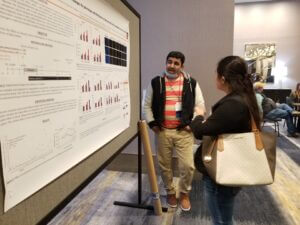 DCRC Scholar Ali Husnain reflects on his annual meeting experience
By Ali Husnain, University of Florida PhD Candidate
A farm born boy and veterinarian by training, I have great passion for bovine reproduction. During my master’s degree training in Pakistan, I had the chance to work in a collaborated project with Michigan State University. Through this project, I had the opportunity to learn applied dairy cattle reproduction and how improved reproductive efficiency can benefit dairy producers. I also worked on improving Holstein cow reproduction via cattle imported from the United States under a U.S. Department of Agriculture project that led to the path for my PhD at the University of Florida with Jose E.P. Santos – under the Fulbright fellowship program.
Being selected as the 2021 Dairy Cattle Reproduction Council (DCRC) Scholar to attend the DCRC Annual Meeting in Kansas City, Mo., was an honor. This program provided me with an excellent opportunity for networking with industry professionals and to learn more about cutting-edge research and hot topics in the dairy industry related to reproduction. Furthermore, I presented data from my graduate work experiments, which look to understand the effect of uterine inflammation on endometrial immune cell population and phenotype in dairy heifers that could potentially be linked with compromised pregnancy due to uterine diseases.
I enjoyed the DCRC Annual Meeting’s outstanding speakers and diversity of presentations. The topics covered were relevant to my interests and useful for dairy producers. Talking with experts and listening to the presentations expanded my knowledge in the areas of dairy reproduction that were applicable and practical. I found the panel discussions revolving around dairy heifer reproductive management and sire fertility very interesting. The information presented allowed me to learn more about potential implications for the dairy industry. Also, these presentations provided a holistic representation of dairy reproduction.
Between breakout sessions, I appreciated the poster session for the opportunity to present data on exploring the effect of uterine inflammation on distribution of endometrial immune cells and phenotype in an effort to share the proposed mechanism of immune-activated pregnancy loss in cattle. I found the poster session very engaging and I enjoyed interacting one on one with meeting attendees to discuss my research. It was great to network with other graduate students and industry professionals during the poster session to learn more about their research and job-related priorities and interests.
I applaud DCRC and its members for their dedication to recognizing dairy herds excelling in reproductive management and providing these herds the opportunity to interact and share their journey and experiences with members. I believe this serves as a great reminder of how far the dairy industry has come in improving reproductive performance. This speaks volumes on the importance of research conducted in dairy cattle reproduction and its ability to improve herd performance. As the dairy industry continues to evolve, I hope to see these relationships among herds and reproductive research strengthen.
Thank you again to the DCRC board of directors and its members for creating the DCRC Scholars program, which provided me the opportunity to attend the annual meeting. It was great to connect with others who are very passionate about the dairy industry and reproductive physiology. The connections and knowledge I obtained from the annual meeting are truly invaluable and I look forward to disseminating the knowledge and ideas to the dairy industry in Pakistan – upon my return after completing my PhD program.
Webinar
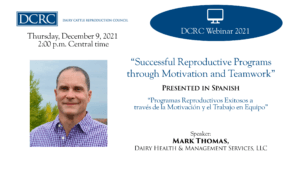 DCRC webinar, presented in Spanish, highlights impact of health on fertility
“Successful Reproductive Programs through Motivation and Teamwork” (Programas Reproductivos Exitosos a través de la Motivación y el Trabajo en Equipo”), presented in Spanish, headlines the next Dairy Cattle Reproduction Council (DCRC) webinar. The free webinar starts at 2 p.m. Central time on Dec. 9. Mark Thomas, Dairy Health & Management Services, LLC managing partner & research team co-lead, Lowville, N.Y., will serve as the instructor for this one-hour webinar.
To register for this webinar, go to: https://bit.ly/DCRCMarkThomasWebinar. If you are a DCRC member and cannot attend the live program, you may access the webinar at www.dcrcouncil.org (about two weeks after the webinar).
During the webinar, Thomas will share an overview of management, motivation and team building of employee teams to achieve success in reproductive programs.
Thomas earned his bachelor’s and Doctor of Veterinary Medicine degrees from Cornell University. Following graduation, Thomas entered clinical practice at Countryside Veterinary Clinic, LLP in northern New York, where he was a partner for 19 years. In 2012, he joined other colleagues and founded Dairy Health to provide bioeconomic, decision-based consulting and research to dairy clients. Within the practice, Thomas focuses on production and preventative medicine. In addition to routine veterinary care, he provides consulting services in the areas of nutrition, reproduction, milk quality and replacement rearing. He works with dairy health teams in the United States, Mexico and China.
Industry Calendar
- Council on Dairy Cattle Breeding Triannual Evaluation, December 7
- Dairy Cattle Reproduction Council webinar (presented in Spanish), December 9, at 2 p.m. Central time
- National Mastitis Council Annual Meeting, February 1-3, San Diego, California
- Dairy-Tech, Stoneleigh Park, Coventry, United Kingdom, February 2
- National DHIA Annual Meeting, February 21-24, San Antonio, Texas
- High Plains Dairy Conference, March 1-2, Amarillo, Texas
- Professional Dairy Producers of Wisconsin Business Conference, March 16-17, Wisconsin Dells, Wisconsin
- Central Plains Dairy Expo, March 29-31, Sioux Falls, South Dakota
- Council on Dairy Cattle Breeding Triannual Evaluation, April 5
- National Conference on Interstate Milk Shipments, April 7-12, Indianapolis, Indiana
- Dairy Calf and Heifer Association Annual Conference, April 12-14, Bloomington, Minnesota
- Animal Agriculture Alliance Stakeholders Summit, May 11-12, Kansas City, Missouri
- ICAR/Interbull, May 30-June 3, Montreal, Quebec, Canada
- American Dairy Science Association Annual Meeting, June 19-22, Kansas City, Missouri
- National Mastitis Council Regional Meeting, July 12-14, East Lansing, Michigan
- Lameness in Ruminants Conference, August 1-5, Bloomington, Minnesota
- Council on Dairy Cattle Breeding Triannual Evaluation, August 9
- American Association of Bovine Practitioners Annual Conference, September 22-24, Long Beach, California
- World Dairy Expo, October 2-7, Madison, Wisconsin
- Dairy Cattle Reproduction Council Annual Meeting, November 15-17, Middleton, Wisconsin
- Council on Dairy Cattle Breeding Triannual Evaluation, December 6
