
Newsletter – 2022 – August
President's message
 From the DCRC President’s Desk
By Matt Utt
Hello DCRC membership!
I hope the first two months of your summer have been filled with fun and memorable occasions. One thing I have noticed since I last wrote to you is there appears to be a positive correlation between daily temperature and prices paid at the gas pump, groceries stores and elsewhere. Of course, this is not cause and effect, just the world we live in at the moment!
Some excellent educational opportunities took place over the last two months. June was a big month for the American Dairy Science Association (ADSA). The 43rd ADSA Discover Conference, titled “Dairy Cattle Reproduction: Lessons Learned and Future Frontiers,” was held the week of June 1. This intimately sized group listened to presentations and held discussions on key topics, such as linking basic reproductive biology to reproductive management, promoting reproductive success through improved health and nutrition, using automation and data to make more informed reproductive management decisions, new frontiers in genetics and assisted reproductive technologies, and fostering collaboration between universities and industry. This conference was followed by the ADSA Annual Meeting later in the month.
Although exponentially larger and presenting a wider variety of topics, the ADSA Annual Meeting still had a somewhat intimate feel to it. It is always refreshing to listen to a wide variety of presentations covering topics spanning ruminant nutrition, dairy management, reproduction, physiology, genetics, animal welfare, dairy products and more. If you enjoy a wide variety of topics pertaining to dairy management, remember DCRC is not just about reproduction. Our materials, webinars and annual meeting cover the gamut of topics mentioned above. Why? Because we realize that dairy reproductive performance, efficiency and profitability are affected by more than one factor.
I hope your calendar is marked for Nov. 15-17, to attend the DCRC Annual Meeting in Middleton, Wis. (located west of Madison). The program is shaping up nicely with a variety of relevant topics. One unique component of this year’s meeting is the offering of dairy farm tours, which features DCRC Excellence in Dairy Reproduction Award winners: Darlington Ridge Farms, Kieler Farms, Schilling Farm and Wessel Farms.
The DCRC leadership team is always looking for ways to improve the content we offer our membership at the annual meeting, as well as growing our membership. One way to achieve both goals is by partnering with other industry professional organizations. If you belong to such an organizations and feel partnering with DCRC would benefit both organizations, please talk with me or someone else from the DCRC leadership team.
Lastly, we just had two webinars in the month of July. What do you think about our webinar series? What are other topics should we consider for potential webinars? Look for a posting on the DCRC Facebook page asking these questions. If you post feedback as a comment, you will be entered to a drawing for merchandise from the DCRC store!
Safe travels for the rest of your summer adventures. I look forward to seeing you in person in a few months!
Research Summaries
The relationships between early lactation energy status indicators and endocrine fertility traits in dairy cows
P. Mäntysaari, J. Juga, M.H. Lidauer, J. Häggman, T. Mehtiö, J.M. Christensen, and E.A. Mäntysaari
During the first weeks of lactation, high-producing dairy cows frequently demand greater energy than what is obtained from their diet. In this situation, cows mobilize energy from their body tissue, which results in negative energy status. The deleterious effects of negative energy status on health and reproductive performance of dairy cows are well known. Objectives of this study were to assess the associations of postpartum energy status and fertility traits, and to evaluate the usefulness of different indicators to predict energy status during early lactation.
Materials and methods
• The study was performed using data from 11 Finnish dairy herds.
• All herds used automatic milking systems with an integrated function (HS) used to evaluate:
– Daily progesterone concentration in milk between 20 and 100 days in milk (DIM)
– Beta-hydroxybutyrate (BHB) concentration in milk every fourth day between 8 and 63 DIM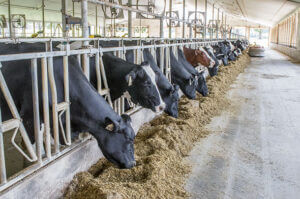
• Test-day milk samples were collected to evaluate indicators of energy balance:
– Milk fat:protein ratio
– Concentration of C18:1 cis-9
– Ratio of fatty acids (C18:1 cis-9/C10:0)
– Predicted plasma non-esterified fatty acids (NEFA) concentration
Results
• Average interval from calving to initiation of luteal activity was 39.9 + 16.6 days (d).
• Average interval from calving to first heat was 50.7 + 17.2 d.
• Correlations between fertility traits and energy status tended to be greater for multiparous (r < 0.28) than for primiparous cows (r < 0.16).
• Associations were observed between fertility traits and energy status.
In conclusion, associations observed between fertility traits and energy status in this study suggest that negative energy status in the first weeks after parturition may delay the initiation of luteal activity. In addition, predictions of plasma NEFA and milk fatty acids based on test-day samples subjected to mid-infrared spectra analyses or on data provided by the automated milking system using frequent measurements of milk BHB resulted in equally good predictions of energy status during the postpartum period.
Access the paper at https://doi.org/10.3168/jds.2021-21077
Effect of nerve growth factor-β administered at insemination for lactating Holstein dairy cows bred after timed-artificial insemination protocol
A.M. Hubner, I.F. Canisso, P.M. Peixoto, W.M. Coelho Jr., L.L. Cunha, L. Ribeiro, S. Crump, and F.S. Lima
Nerve growth factor-β (NGF) is a seminal plasma protein that has been shown to induce ovulation in camelids, partially due to the increase of luteinizing hormone (LH) output from the pituitary gland. In cattle, intramuscular injection of NGF increased LH release, pre-ovulatory follicle size, and circulating progesterone concentrations. The objectives of the study were to evaluate the effect of administering NGF purified from bull seminal plasma at timed artificial insemination (AI) on reproductive outcomes of lactating dairy cows.
Animals enrolled, treatment groups, timed AI protocol, and variables assessed
A total of 557 lactating cows were enrolled in the study at 38 ± 3 days in milk.
• First service synchronization protocol consisted of gonadotropin releasing hormone (GnRH) injection at day (d) 0 (start of the protocol), PGF2α (prostaglandin F2α) at d 7, GnRH at d 10, followed by CoSynch starting 7 d later.
• Cows were randomly allocated to receive intramuscular injections of 296 µg of NGF in 2 mL of PBS (n = 275) or 2 mL of PBS (n = 282). Injections were administered at day of timed AI.
• Assessment of ovarian structures was performed via ultrasonography for a subset of animals.
• In addition to pregnancy outcomes (P/AI at 37 and 65 d post-AI), plasma progesterone concentrations and interferon-stimulated genes were assessed.
Results
• NGF did not improve P/AI at 37 d post-AI (NGF = 40.0% vs. control = 41.6%) or at 65 d post-AI (NGF = 36.0% vs. control = 38.1%).
• NGF did not impact pregnancy loss (NGF = 8.4% vs. control = 7.7%).
• Corpus luteum (CL) size was not affected by treatment.
• NGF increased progesterone concentrations for primiparous cows but not for multiparous cows.
• No differences in interferon-stimulated genes were observed between NGF and control cows.
Although injection of NGF at timed AI increased circulating progesterone concentration for primiparous cows, it did not improve pregnancy outcomes, CL size, and upregulation of interferon-stimulated genes.
Access the paper at: https://www.journalofdairyscience.org/article/S0022-0302(22)00321-6/fulltext
Environmental factors affecting the conception rates of nulliparous and primiparous dairy cattle
H. Ukita, T. Yamazaki, S. Yamaguchi, H. Abe, T. Baba, H. Bai, M. Takahashi, and M. Kawahara
Profitability in dairy operations is greatly influenced by conception rates after artificial insemination (AI). Several studies demonstrated that conception rates are greater for nulliparous compared with primiparous and multiparous dairy cattle. More studies, however, are needed to better understand the effects of environmental factors on conception rates after AI, specifically in nulliparous and primiparous dairy cows. The objective of this study was to investigate the environmental factors associated with conception rates after first AI in nulliparous and primiparous Holstein cows.
Materials and methods
• Data were collected from commercial dairy herds in Japan through the Dairy Herd Improvement Program.
• In total, AI records from 533,672 nulliparous and 516,710 primiparous Holstein cows were used.
• Only records from first services were used to eliminate the effect of the number of inseminations on conception.
• Association between conception rate after AI and several other factors were evaluated. Some of the factors considered in the analyses were:
– Age at insemination (for nulliparous)
– Month of the year when AI was performed
– Semen type (conventional vs. sexed semen)
– Semen breed (Holstein vs. beef)
– Country of origin of semen
– Calving difficulty score
– Milk yield at peak (for primiparous)
– Interval from calving to first AI (for primiparous)
Results
• Average conception rates after first AI were 55.2 and 39.2% for nulliparous and primiparous cows, respectively.
• Semen type had a strong effect on conception rates after first AI, as follows:
– Nulliparous: Conventional – 62.4%; Sexed – 51.9%
– Primiparous: Conventional – 39.3%; Sexed – 30.9%
• Semen breed was associated with conception rates, as follows:
– Nulliparous: Holstein – 54.3%; Beef – 60.2%
– Primiparous: Holstein – 34.0%; Beef – 40.5%
• For primiparous, greater milk production at peak was associated with lower conception after first AI.
• Conception rate increased in primiparous cows inseminated for the first time after 60 days in milk, regardless of peak milk yield.
In conclusion, findings from this study suggest that semen type has a greater impact on conception after first AI than other factors, in both nulliparous and primiparous Holstein cows. In addition, this study provides evidence that there is a combined effect of peak milk yield and interval from calving to first insemination on conception rate after first AI in primiparous cows.
Access the paper at https://doi.org/10.3168/jds.2022-21948
Featured Column
Breeding decisions for the future
What is the ideal cow? That answer depends on your perspective. Thus, it can be challenging for groups (e.g., Council on Dairy Cattle Breeding, Agricultural Research Service, dairy producers and university experts) to achieve consensus.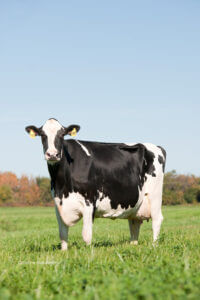
Historically, the lifetime net merit (NM$) index placed emphasis on yield traits. (NM$ ranks dairy animals based on their combined genetic merit for economically important traits.) More recently, emphasis has shifted from yield traits to fertility, health and fitness traits, according to John B. Cole, URUS Group LP, Madison, Wis., who spoke at the 2021 Dairy Cattle Reproduction Council Annual Meeting.
While consensus can be challenging, selection indices are essential tools in modern dairy cattle breeding because they allow information about many traits to be combined into a single value for ranking animals and making selection decisions. Table 1 shows the selection indices – and relative emphasis – that the U.S. Department of Agriculture used from 1971-2021.
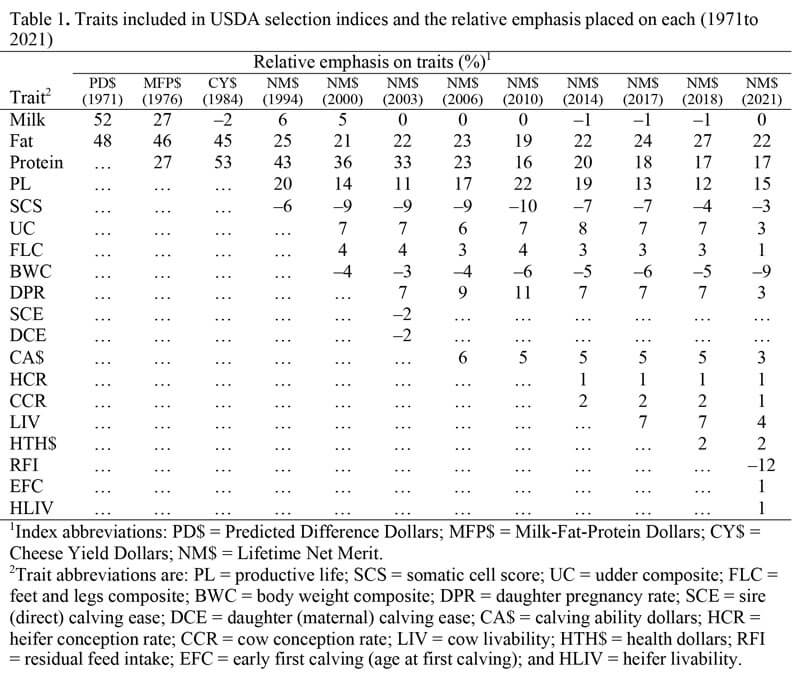
“Periodically, indices are updated to include new traits and reflect changing economic conditions, as well as changing genetic parameters between and among traits,” Cole explained. A collaborative model, with input from key participants in the dairy breeding sector, proposes and adopts changes to the indices. Cole noted that the collaboration drives increased adoption of the indices and builds support for other communal efforts, such as the recording of new phenotypes so that they may eventually be included in the index.
One of the challenges with indices today is the variety of dairy operations. Forty-plus years ago, dairies were more “homogenous” – similar size and management style. Today, the dairy industry includes small-, medium- and large-sized dairy operations. Many use conventional management practices, yet some focus on grazing, organic and/or elite dairy cattle genetic business models. Thus, these more unique enterprises may desire a tailored index.
Consider the environment
This leads to the implications of environment – not just genetics – on cattle performance. Cole shared that one of the core assumptions underlying genetic improvement programs is the maxim “P = G + E,” which tells us that the phenotype (P) we observe is the sum of both genetic (G) and environmental (E) effects. “Although a selection index focuses specifically on G through its prediction of an individual’s aggregate breeding value, there is growing interest among farmers for improved predictions that include both genetic and environmental components.”
Cole explained that data analysts divide environmental effects into two groups – permanent (e.g., geographic location) and temporary (e.g., ration). Temporary effects are difficult to model, but permanent effects can be modeled and used to help with decision making. “For example, most probable producing ability adds permanent environmental effects to estimates of additive genetic merit to provide estimates of an individual’s phenotypic performance.”
With advancing technologies, the dairy industry can now collect novel phenotypes, such as milk composition and animal behavior, on a large scale – often in real time. Compared with plant improvement programs, livestock production systems are still in the early stages of high-throughput phenotyping. Despite being in its infancy, Cole predicts growing demand from dairy farmers to include these data sources in genetic evaluation programs as the available technologies grow in number and increase in utility.
While some entities may develop and offer their own selection tools, Cole is a firm believer that genetic evaluations are most effective when they are treated as a shared resource. “But, there is room for tremendous innovation in how those evaluations are used to make decisions,” he stated.
Cole concluded, “The rate of change is rapid and farmers need objective sources of transparent information more than ever before. The best way for the industry to meet the needs of dairy producers, who drive the whole system, is to treat genetic evaluations as a shared good for the benefit of all.”
For more details, read Cole’s DCRC Annual Meeting proceedings paper, which can be found in the DCRC Member Center. After you log in, click on the Proceedings icon. References may be found in the paper.
Featured Member
Editor’s Note: For each issue, DCRC interviews a member to learn more about his/her career, involvement with DCRC and thoughts about dairy cattle and reproduction. We encourage you to recommend someone for this feature by contacting JoDee Sattler at: JoDee@dcrcouncil.org

Carli Woodward
Phibro Animal Health
Dallastown, Pennsylvania
DCRC member since 2016
Carli Woodward, an account manager on the Dairy Team at Phibro Animal Health, is a prime example of a “non-farm kid” growing her career in the dairy industry. However, she gained farm experience by working on an educational farm in New York’s Hudson Valley region.
“I spent my summers at Farm Camp and then worked on the farm after school, on the weekends and in the summers,” Woodward explained. After high school, she went to Penn State University – majoring in animal science – and gained most of her initial agricultural experience through extra-curricular activities.
At Phibro, Woodward is responsible for selling and servicing the company’s nutrition specialty products. Phibro is a global animal health organization that offers solutions to help support the health of all animal species, including cattle, poultry, swine and aquaculture.
Woodward’s early interest in dairy cattle reproduction started when she began working for Select Sires in 2016. That’s when she was introduced to the Dairy Cattle Reproduction Council (DCRC). Currently, she serves as the DCRC Membership Committee chair.
By being a DCRC member, Woodward has gained valuable resources. Her DCRC involvement introduced her to numerous experts in the dairy cattle reproduction field. “Coming from limited experience in the dairy industry, attending the DCRC Annual Meeting helped me meet the leading experts and learn about their latest research.”
In addition, Woodward appreciates hearing the success stories from winners of the DCRC Excellence in Dairy Reproduction Awards program. “These stories taught me early on in my career that success can come from several different repro programs and ideas,” she stated. “There is no ‘one size fits all’ approach.”
DCRC has played a key role in helping numerous dairy herds improve their reproduction results. Like many of her colleagues, Woodward directs producers and her professional peers to look at the DCRC website (www.dcrcouncil.org). “I find the DCRC website a good starting point for using DCRC as a resource.”
Since DCRC’s inception, dairy cattle repro programs have improved significantly. This success has come with a challenge – too many replacement heifers. “In doing so, we have increased the number of heifers on farms and lowered the average age of cows,” Woodward remarked. “As the industry focuses on increasing cow longevity on dairy farms, it may be a little harder to get those older cows bred.”
Looking ahead, Woodward predicts that DCRC will continue to grow and be influential to producers. “I think it will be exciting to watch as DCRC continues to bring new ideas and technologies into the repro space.”
Industry Calendar
- Council on Dairy Cattle Breeding Triannual Evaluation, August 9
- Fetch dvm360 Conference, August 26-28, Kansas City, Missouri
- American Association of Bovine Practitioners Annual Conference, September 22-24, Long Beach, California
- World Brown Swiss Conference, October 2-6, Madison, Wisconsin
- World Dairy Expo, October 2-7, Madison, Wisconsin
- Council on Dairy Cattle Breeding Industry Meeting, October 5, Madison, Wisconsin
- U.S. Animal Health Association Annual Meeting, October 5-13, Minneapolis, Minnesota
- International Colloquium on Paratuberculosis, October 17-21, Jaipur, India
- Dairy Girl Network National Conference, November 1-3, Prior Lake, Minnesota
- Dairy Cattle Reproduction Council Annual Meeting, November 15-17, Middleton, Wisconsin
- Council on Dairy Cattle Breeding Triannual Evaluation, December 6
