
Newsletter – 2024 – April
President's Message
By Tracy Burnett, University of Guelph, Ridgetown Campus

DCRC President, Tracy Burnett
Greetings from Ontario, Canada!
The Dairy Cattle Reproduction Council (DCRC) is once again calling for nominations for its 2024 DCRC Scholar Program! This program aims to support outstanding graduate students and young scientists focused on furthering reproductive science in dairy cattle. Recipients receive a scholarship of up to $1,500 to offset costs (such as airfare, hotel, registration, meals) related to attending the DCRC Annual Meeting in Arlington, Texas, from Nov. 12-14. To be eligible for the program, applicants must be full-time graduate students at a college or university in a program specializing in dairy cattle reproduction. The student is also required to be a DCRC member. The application includes an application form and a one-page interest statement covering their interests in dairy cattle reproduction, career goals, interest in the DCRC meetings, and their current research. In addition, applicants need a recommendation letter from a faculty member of their university, and a list of achievements (such as scholarships, degrees, awards, etc.). Applications for the DCRC Scholar Program are due April 30, and award decisions will be returned by May 31. The winner will be asked to submit a poster for presentation at the DCRC Annual Meeting, as well as a summary of their experience at the meeting. For more information on the DRCR Scholars Program, visit https://www.dcrcouncil.org/dairy-cattle-reproduction-council-scholars-program.
In addition to our Scholar Program, we are also looking for nominations for our Excellence in Dairy Reproduction Awards program. Judges will evaluate all nominations based on reproductive performance criteria and then select finalists from the pool of nominees with excellent reproductive management and success. Finalists will be asked to submit additional herd management data from their herd management software (such as DairyComp305, BoviSync, DHI Plus, PC Dart) for further assessment. Herds recognized with Platinum, Gold, Silver, or Bronze distinctions will be invited to attend the DCRC Annual Meeting. Remember, nominations must be submitted by professionals within the dairy industry, such as veterinarians, representatives from genetic and pharmaceutical companies, DHIA field personnel, or Extension specialists. The deadline for nominations is April 30, and they should reflect reproductive performance data from Jan. 1-Dec. 31, 2023. To nominate a herd, visit https://www.dcrcouncil.org/awards/nominate-a-herd and provide the necessary information. You may also reach out to JoDee Sattler at jodee@dcrcouncil.org if you have additional questions.
In March, DCRC Vice President Ralph Bruno represented DCRC at the High Plains Dairy conference in Amarillo, Texas. The numerous producers and industry representatives who attended learned from top industry experts on topics related to the dairy industry’s future, with a focus on financial perspectives, manure and greenhouse gas management strategies, dairy cattle reproduction, innovative management techniques and new technologies.
Conference Co-chairs Robert Hagevoort (New Mexico State University) and Jennifer Spencer (TA&M Agrilife Extension and DCRC membership committee chair) welcomed DCRC to the conference and allowed Ralph to share DCRC’s goals and projects, which were well received by the audience. Several producers approached Ralph during the meeting to learn more about DCRC and the 2024 DCRC Annual Meeting set for Nov. 12-14, in Arlington, Texas.
“It was definitely a great opportunity for DCRC to advertise its projects and programs directly to dairy producers,” Ralph commented. “Thanks to the 2024 High Plains Dairy Conference Planning Committee for giving us the opportunity to share our organization’s goals and projects.”
Research Summaries
How does a beef x dairy calving affect the dairy cow’s following lactation?
R.E. Espinola Alfonso, W.F. Fikse, M.P.L. Calus, and E. Strandberg
Beef semen usage on dairy cows has progressively increased over the years. And although much of the research has focused on the performance of the crossbred calves, limited information is available regarding the subsequent performance of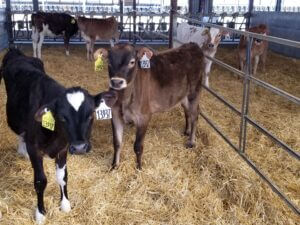 the dam. This study aimed to evaluate the performance of dairy cows for milk yield, fertility, and survival traits after giving birth to beef x dairy crossbred calves and compared this with the performance after giving birth to purebred dairy calves.
Study population and outcomes
- Data from the Swedish database included the phenotypic records from 587,288 calving events from 1997 to 2020.
- Production indicators, such as cumulative milk yield, protein yield, and fat yield; reproductive performance indicators, such as calving to first insemination interval, first to last insemination interval, and number of inseminations; and survival to the next lactation were assessed according to the type of breeding.
- Data from first- and second-lactation Swedish Red and Swedish Holstein, bred to either beef sires (Aberdeen Angus, Charolais, Hereford, Limousin, and Simmental) or dairy sires, were used for analysis.
Results
- Milk yield was lower after beef x dairy calvings compared with purebred dairy calvings. The largest effects were found on cumulative yields, with lower effects for yields early in lactation. The largest decrease was 13 to14 kg for cumulative fat yield when breeding beef breed sires with purebred Swedish Red dams.
- For most breed combinations, the effects for fertility traits were not large enough to be significant.
- All beef x dairy crossbred combinations showed significantly lower results for survival to the next lactation and lactation length.
- There was some indication that dairy cows with beef x dairy calvings in parity 2 that were the result of a maximum 2 inseminations in parity 1 had lower survival than corresponding calvings resulting from more than 2 inseminations. This could indicate that the former cows were marked for culling already when inseminated.
In conclusion, cows having a beef x dairy calving had lower milk, fat, and protein yields in the following lactation compared with cows that had dairy x dairy calvings; however, fertility traits were mostly not significantly affected. In addition, cows having had a beef x dairy calving had lower survival to the next lactation compared with cows that had dairy x dairy calvings.
Access the paper at: https://www.sciencedirect.com/science/article/pii/S0022030224000614?via%3Dihub
Effect of 200 μg of gonadorelin hydrochloride at the first GnRH of a CIDR Synch program on ovulation rate and pregnancies per AI in Holstein heifers
D.B. Melo, W.M. Coelho Jr, T.C. Marques, S. Salman, I.M. Macedo, T. Castro, M.C.G. Menezes, H.F. Monteiro, R.F. Cotterman, A.J. Conley, and F.S. Lima
Fertility programs are proven to improve pregnancy outcomes in dairy animals. However, initial ovulatory responses during these programs are lower for heifers compared with cows. That may have some relationship with heifers having a different follicular dynamic, progesterone secretion, and more than 40% of them exhibiting three follicular waves. Previous studies have shown that doubling (2 cc; 100 μg vs. 4 cc; 200 μg) in estrous synchronization programs increased the plasma concentration of luteinizing hormone (LH) released and improved ovulatory response and pregnancy in dairy cows. The current study hypothesis was that administering double (100 vs. 200 μg) the maximum label recommendation of gonadotropin releasing hormone (GnRH; 50 μg gonadorelin hydrochloride per mL) at the first hormone administration of a 6-day CoSynch plus P4 device program would improve ovulation and pregnancy per artificial insemination (AI) in the first service of Holstein heifers.
Animal inclusion criteria and hormone use
This study collected data from 1,308 nulliparous Holstein heifers housed in a cattle feeder in Nevada.
- The study was conducted between February and May 2022.
- Heifers were expected to reach approximately 794 pounds and had an average daily gain (ADG) of 1.76 pounds/day. They stayed in the same pen from enrollment to the last pregnancy diagnosis.
- At enrollment (Day 0), heifers had their body condition score (BCS) assessed, were ranked according to the genomic prediction of daughter pregnancy rate (GDPR), were randomly assigned to either treatment (100 μg, 2CC, n=655; or 200 μg, 4CC, n=653), and had a controlled internal drug release (CIDR) inserted (1.38 g of progesterone; P4). All procedures in the following days were the same for all heifers following a 6-day CoSynch protocol.
- Transrectal ultrasonography evaluation was performed to evaluate ovarian response (n=396) on days 0 and 6 of the protocol and pregnancy diagnosis at day 37 post timed AI (n=1,308). Transrectal palpation of uterine contents was performed on days 79 and 177 post-AI.
- Blood samples were collected on days 0 and 6 to have P4 (progesterone) evaluated and classified as High (>3 ng/mL) or Low (≤3 ng/mL) P4 concentration.
Results
- The 4-cc group had greater ovulatory response compared to 2-cc heifers (54.7% vs. 42.8%).
- Ovulatory response at day 0 was greater for Low P4 than High P4 (54.3% vs. 37.8%).
- Heifers that ovulated had increased pregnancies per AI (P/AI) (67.7% vs. 55.6%).
- Pregnancy outcomes were not different between treatment groups (2 cc vs. 4 cc).
- There was no difference for blood P4 concentrations between treatment groups (2 cc vs. 4 cc).
In conclusion, increasing the dose of GnRH from 100 to 200 μg at day 0 of a 6-day CIDR synchronization program improves ovulatory response in Holstein heifers. Pregnancy outcomes were not affected. This study suggests that only increasing the GnRH dose may not be sufficient for enhancing overall pregnancy.
Access the paper at: https://www.journalofdairyscience.org/article/S0022-0302(24)00527-7/fulltext
Effects of timing of oral calcium administration on milk production in high-producing early-lactation Holstein cows
C.R. Seely, C.N. Wilbur, K.M. Fang, and J.A.A. McArt
Clinical or subclinical hypocalcemia affects lactation performance. Recent studies have shown that blanket supplementation of an oral calcium (Ca) bolus to all cows has limited benefits on lactation. Decreased blood Ca at 4 days in milk (DIM) has greater association with negative outcomes throughout lactation than 0 to 24 hours after parturition, when current Ca bolus supplementation is recommended. The researchers aimed to explore the effects of delaying oral Ca bolus to 2 and 3 DIM on milk production and the differences in disease incidence. The hypothesis was that delaying Ca supplementation would improve milk production and blood Ca in early postpartum, and decrease the incidence of disease.
Study design, herd inclusion criteria, animal eligibility, and treatments
Data from this study was collected from four farms in northeastern New York, USA.
- Data were collected from June 2 to July 10, 2021, and July 15 to Sept. 25, 2021.
- Farms had to milk at least 1,000 Holstein cows 3 times a day, have headlocks in the fresh pens, feed a total mixed ration (TMR) and experience a negative prepartum dietary cation-anion difference (DCAD), record daily milk weights, and use DairyComp software.
- Only enrolled cows entering second lactation or greater (n=998) and they were assigned to 1 of the 3 treatments they had (CON=control group, no Ca supplementation, n=343; BOL-C=supplementation of Ca Bolus at 0 and 24 hours after parturition, n=330; BOL-D=supplementation of Ca bolus at 48 and 72 hours after parturition, n=325).
- Blood samples were collected at 1 and 4 DIM after parturition, before administration of Ca bolus. Blood serum was analyzed. Dyscalcemia was defined as tCa <2.2 mmol/L at 4 DIM.
- Health events before 30 DIM and first 10 weeks of milk yield data were extracted from DairyComp.
Results
- Parity 3 cows from BOL-D produced more milk compared with parity 3 from other treatment groups (P<0.001). No difference between parities 2 and >3.
- Disease incidence was low and similar among treatment groups.
- Cows from parity 4 and greater from BOL-D had lower total Ca concentration than the other groups (P=0.04).
In conclusion, delaying Ca supplementation had limited influence on blood Ca concentrations. Data suggested that it would benefit target groups of cows if used as a prophylactic treatment to support milk production.
Access the paper at: https://www.journalofdairyscience.org/article/S0022-0302(23)00712-9/fulltext
Featured Column
Can early embryonic losses be reduced?
During the 2023 Dairy Cattle Reproduction Council (DCRC) Annual Meeting, Peter Hansen, University of Florida, made a bold statement. “Early embryonic losses in lactating dairy cows can be reduced.”
For background, Hansen explained that about 32% of embryos die between days 19 and 32 of gestation. He gave two reasons why early embryonic losses could be lowered.
First, high-fertility herds (e.g., pregnancies per insemination average >50% or more) incorporate technologies that increase reproductive function, including timed artificial insemination (AI), improved transition cow management to reduce metabolic, inflammatory, and infectious disease, and genetic selection for relatively new traits, such as daughter pregnancy rate and/or cow conception rate. “As these technologies become adopted by more dairy herds, cattle fertility (on a national basis) will rise,” Hansen stated.
“Second, new approaches to improve pregnancy outcomes will emerge from research to better understand the biological determinants of a successful pregnancy,” Hansen continued. “Building on the intellectual framework already established, current experimentation is helping enrich our understanding of the cellular, molecular, and genetic relationships between the breeding female, the male and female gametes, and the embryo that together determine pregnancy outcomes.” Hansen’s presentation focused on emerging science related to pregnancy’s biological determinants.
Why cows experience reduced oocyte competence
Hansen shared two reasons why lactating cows experience reduced oocyte competence – altered follicular growth under a low progesterone environment and ovulation of aged follicles caused by prolonged growth of the preovulatory follicle. “Timed AI programs can alleviate these problems,” he noted. Other oocyte challenges include heat stress and uterine infections.
With more being learned about how cells regulate internal homeostasis in the face of cellular stress, Hansen is hopeful that strategies can be identified for upregulating cell survival molecules in the oocyte or surrounding follicular cells to reduce damage to the oocyte in the postpartum cow. For example, Pollard et al. (2022) summarized the role of nicotinamide adenine dinucleotide (NAD+) as a substrate for the sirtuin and poly-ADP-ribose polymerase protein families involved in cellular homeostasis. They suggested that supplementation of oocyte or embryo culture media with NAD+ might enhance oocyte or embryo function. “The same might be true for the postpartum cow,” Hansen commented. Niacin is a precursor for NAD+, but little work has been done on supplement niacin to improve postpartum cows’ fertility.
What can be done to reduce the impact of calving and lactation on a cow’s reproductive tract to maintain pregnancy? Hansen explained that lactation changes endometrial gene expression and reduces maternal support for embryonic development. “The mechanisms involved are multifactorial,” he stated. Little is known about the process of “rebuilding” the endometrium after calving. Examining the endometrial epithelium’s ultrastructure revealed its complexity. Researchers discovered an uneven distribution of ciliated cells, clustered near the openings of endometrial glands, and existence of microvilli-rich apical protrusions of epithelial cells called pinopodes. These appear to form and regress over time.
Additionally, an influx of immune cells enter the endometrium. In humans, recurrent pregnancy loss has been associated with errors in the decidual response in the pregnant endometrium, including defects in influx of bone marrow-derived mesenchymal stem cells. “While decidua does not form in the bovine uterus, it is possible that the endometrium of the postpartum cow is lacking numbers or functions of specific endometrial cell populations derived in situ or from outside the uterus,” said Hansen.
Improve maternal-embryo communication
Hansen called for more research related to communication between the developing embryo and the female reproductive tract’s endosalpinx and endometrium. He believes that maternal-embryo communication disorders, due to altered ligand secretion or receptor synthesis, may lead to embryo development failure.
Without question, health status influences a cow’s fertility. “Cows that experience one or more clinical diseases in the postpartum period have reduced probability of a successful pregnancy after breeding,” Hansen stated. It doesn’t matter if the illness was classified as a uterine or non-uterine disease, or diagnosed during the preantral follicle growth, antral follicle growth, or early post-breeding period.
“The fact that so many different conditions associated with activation of innate or acquired immune responses can all lead to reduced fertility suggests there are some common mechanisms,” Hansen explained. “One might be the nutritional consequences of immune responses, including anorexia and the energetic costs of an immune response.”
Prevent uterine diseases
For embryo transfer recipients, uterine diseases are a more important impediment to a successful pregnancy than other diseases. Single-cell omics technologies offer new tools for examining why uterine diseases impair fertility.
As omics technologies and machine learning progress, Hansen believes these advancements will provide tools to develop markers of oocyte, embryo, and cow competence to establish pregnancy. By analyzing transcriptomic data, researchers found biomarkers of uterine receptivity at day 7 after estrus and competence of the bovine blastocyst to establish pregnancy after embryo transfer. “These or other biomarkers should prove useful in assessing how genetic, physiological, nutritional, and other factors are responsible for variation in fertility among lactating cows and result in new approaches for enhancing the proportion of postpartum cows that are fertile,” Hansen claimed.
References may be found in Hansen’s DCRC Annual Meeting proceedings paper. Log into the DCRC Member Center to read his complete proceedings paper.
Featured Member
Editor’s Note: For each issue, DCRC interviews a member to learn more about his/her career, involvement with DCRC and thoughts about dairy cattle and reproduction.
Augusto Madureira
University of Guelph, Ridgetown Campus
DCRC member since 2013
 Meet Dairy Cattle Reproduction Council’s newest board member – Augusto Madureira, the dairy herdsperson apprenticeship program coordinator at the University of Guelph’s Ridgetown Campus. This is the only apprenticeship available for dairy farming in all of Canada. Madureira’s work responsibilities involve providing education to individuals interested in current dairy practices and expanding their dairy industry knowledge.
“I lead in-class training sessions to students who are predominantly dairy producers or those who work on dairy farms,” Madureira explained. “They come to campus to learn about relevant aspects of the dairy industry, which includes applied farming practices, milking and feeding practices, herd health management, and routine herd maintenance.” Furthermore, Madureira is passionate about conducting research on reproduction physiology – focusing on factors associated with fertility outcomes and technology.
Madureira earned a bachelor’s degree in animal science from São Paulo State University, where he was actively involved in an undergraduate academic association that focused on beef and dairy sciences. This experience ignited his passion for research and extension work in the dairy industry. Madureira pursued a master’s degree at São Paulo State University, where he conducted research on uterine diseases, automated activity monitors, and estrous expression in dairy cattle. For his PhD at the University of British Columbia, Madureira focused on automated technologies for estrous detection and factors affecting estrous expression – demonstrating their significance in on-farm decision making and their associations with fertility and pregnancy outcomes.
“I am interested in dairy cattle reproduction physiology, particularly in estrous expression and fertility outcomes, due to its critical role in dairy herd management and productivity,” Madureira stated. “Understanding these aspects can significantly impact reproductive success, which is essential for maintaining a profitable dairy operation. Additionally, investigating fertility outcomes allows me to explore factors influencing conception and develop strategies to enhance reproductive efficiency.”
Madureira was introduced to DCRC when his poster was selected for presentation at the 2013 DCRC Annual Meeting. “Through DCRC events and communications over the last decade, I learned about the latest advancements in reproductive technologies and management practices in the dairy industry,” he noted.
Looking forward, Madureira feels that the biggest reproductive challenges facing the dairy industry today include managing fertility in high-producing cows and preventing and managing diseases in early postpartum. These challenges affect fertility outcomes.
Webinar
Michael Ballou to address early life calf health during DCRC webinar
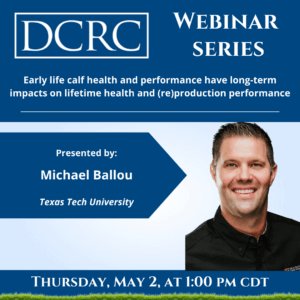 Mark your calendar to attend the next Dairy Cattle Reproduction Council (DCRC) webinar, scheduled for May 2, starting at 1 p.m. Central time (USA/Canada). Texas Tech University Professor Michael Ballou will address “Early life calf health and performance have long-term impacts on lifetime health and (re)production performance.” This one-hour webinar is free.
The presentation will look at the etiology of calfhood diseases. Further, a discussion on various strategies to improve disease resistance will be presented. Lastly, Ballou will show data that indicate that early life health and performance of calves can have long-term impacts on the (re)productivity of the animal.
The webinar’s key learning objectives include:
- Understand why calves are at a high risk for developing infectious disease in early life.
- Know strategies to improve disease resistance and recovery from disease.
- Learn about the long-term impacts of calfhood diseases.
To register for this DCRC webinar, go to: https://bit.ly/DCRCMay2. As the webinar time approaches, you will receive an e-mail with information on how to log in to participate. If you are a DCRC member and cannot attend the live program, access the webinar at www.dcrcouncil.org by May 16.
Ballou is the professor and chair of the department of veterinary sciences in the Davis College of Agricultural Sciences and Natural Resources at Texas Tech University. His research program is focused on understanding how nutrition and management influence the health of calves, heifers and transition cows. Ballou received his PhD in nutritional immunology from University of California-Davis in 2007. He has authored or co-authored more than 96 peer-reviewed publications and given more than 125 invited presentations. Also, Ballou has equity ownership in a nutrition solutions company, MB Nutritional Sciences, located in Lubbock, Texas, and two calf-raising facilities (Calf Land in Fair Oaks, Ind., and Double M Ranch in Texico, N.M.).
For more information about DCRC’s webinars, e-mail Raphael Saraiva, DCRC Education Committee chair, at: raphael.saraiva@stgen.com.
Industry Calendar
- International Conference on Precision Dairy Farming and Technology, April 8-9, Rome, Italy
- Dairy Calf & Heifer Association Annual Conference and Trade Show, April 9-11, Westminster, Colorado
- Tri-State Dairy Nutrition Conference, April 15-17, Fort Wayne, Indiana
- Dairy Cattle Reproduction Council webinar, May 2
- National Mastitis Council webinar, May 7
- Animal Agriculture Alliance Stakeholders Summit, May 8-9, Kansas City, Missouri
- International Committee for Animal Recording, May 19-24, Bled, Slovenia
- Dairy Calf & Heifer Association webinar, May 22
- American Dairy Science Association Annual Meeting, June 16-19, West Palm Beach, Florida
- Council on Dairy Cattle Breeding Triannual Evaluation, August 13
- National Mastitis Council Regional Meeting, August 12-14, Ghent, Belgium
