
Newsletter – 2024 – December
President's Message
By Ralph Bruno, Zoetis

What a successful year! The 2024 DCRC Annual Meeting in Arlington, Texas, was outstanding! We enjoyed nice weather, fantastic presentations, exceptional networking opportunities and amazing interactions with our members. Thank you to everyone who attended our annual meeting. This event would not have been possible without the hard work and commitment of our board members and committees who diligently planned throughout the year.
First, I would like to thank our outgoing president, Tracy Burnett, and outgoing secretary-treasurer, Luciano Caixeta, for their hard work and leadership over the past 12 months. I also extend my gratitude to board members Brian Schilling, Kim Egan and Augusto Madureira, as well as Past President BJ Jones, for their contributions and advice to DCRC. Your dedication has been instrumental in our progress.
A special thank you goes to Ben Voelz and JP Martins for their outstanding work on this year’s program and poster organization. Last, but certainly not least, I would like to thank JoDee Sattler, Kristy Mach and their team for their exceptional logistical organization of our events and operations.
I also want to thank all of you, members of this organization, for your valuable support and attendance at our online educational sessions and annual meeting. A big thank you goes to our sponsors as well. Without your financial support, the accomplishments of this organization would not be possible. For the upcoming year, I would like to welcome three new board members – Jennifer Spencer, Texas A&M University, as vice president, Alex Scanavez, Alta Genetics, as secretary-treasurer, and Mark Doornink, Parnell, as a board member.
As we reflect on the state of the dairy industry in 2024, we recognize both the achievements and challenges that define our current landscape. This year has been marked by significant advancements in technology and sustainability practices, which have helped us improve productivity and reduce our environmental footprint. However, we also face substantial hurdles, particularly with the ongoing outbreak of Highly Pathogenic Avian Influenza (HPAI) H5N1, which has affected a few hundred dairies across more than 15 states.
Looking ahead, our resilience and innovation will be key to overcoming obstacles and securing a prosperous future for the dairy industry. We must continue to invest in research, adopt best practices in biosecurity and support each other through these trying times. Together, we can navigate the complexities of our industry and emerge stronger than ever, aligning with our goals at DCRC.
Our next annual meeting will be held in Middleton, Wis., November 11-13. I am excited about the opportunities that lie before us. I encourage other companies to consider joining us as sponsors. Your support is not only an investment in our organization but also in the future of our industry. Additionally, I invite new members to join us at our next annual meeting. It promises to be an event filled with insightful discussions, networking opportunities and a chance to shape our industry’s future.
Thank you once again for your trust and support. I am eager to embark on this journey with all of you and achieve new heights together. It is through our collective efforts that we will continue to advance the field of dairy cattle reproduction and ensure the sustainability and success of our industry.
Feel free to contact me at ralph.bruno@zoetis.com with ideas or suggestions on how to improve DCRC’s effectiveness, reach and sustainability.
Research Summaries
Delaying induction of ovulation and timed AI in a Double-Ovsynch protocol increased expression of estrus and altered first-service reproductive outcomes of lactating dairy cows
A.L. Laplacette, C. Rial, E. Sitko, M.M. Perez, S. Tompkins, M.L. Stangaferro, M.J. Thomas, and J.O. Giordano
Expression of estrus before artificial insemination (AI) in cows undergoing synchronization of ovulation protocols for timed AI (TAI) is linked to improved reproductive performance, potentially due to increased estradiol (E2) secretion in some cows after luteolysis. Investigating the positive impact of delaying ovulation induction on estrous dynamics and fertility during synchronization protocols for TAI is needed. This randomized controlled trial aimed to assess the effect of delayed ovulation induction and TAI on estrous expression and first-service reproductive outcomes in cows synchronized with a Double-Ovsynch protocol. A secondary goal was to evaluate the effect of delayed induction of ovulation on ovarian function in lactating dairy cows in a Double-Ovsynch protocol.
Study population and outcomes assessed
- This trial was conducted on two commercial Holstein dairy farms: Farm A in Colorado (5,407 milking cows) and Farm B in New York (1,521 milking cows), from December 2021 to November 2022.
- Eligible cows had an automated monitoring sensor attached and were not coded as “do not breed.”
- Cows were synchronized with a Double-Ovsynch protocol up to the first PGF2α (PGF-L) of the Breeding-Ovsynch portion of the protocol (Pre-Ovsynch: GnRH, 7 days later PGF2α, 3 days later GnRH, 7 days later Breeding-Ovsynch: GnRH, 7 days later PGF2α, 1 day later PGF2α). At PGF-L, cows blocked by parity (primiparous vs. multiparous) and semen used for first service (sex-sorted dairy vs. conventional beef) were randomly assigned to the G56 (n = 2,338) or G80 (n = 2,334) treatments. Cows in G56 had 56 hours, whereas cows in G80 had 80 hours from PGF-L to ovulation induction with the last GnRH (GnRH2) before AI. For both treatments, TAI was performed approximately 16 hours after GnRH2. Cows with automated estrous alerts between PGF-L and TAI were inseminated at detected estrus (AIE) without GnRH.
- Ovarian function and synchronization responses were evaluated through measurements of circulating progesterone levels and ultrasonographic ovarian examination.
- Binary outcomes were analyzed using logistic regression and continuous outcomes were analyzed with linear regression.
Results
- More cows in the G80 group exhibited estrus before AI and received AIE. However, pregnancy per AI (P/AI) did not differ significantly between the G80 and G56 treatments. Cows in the G80 group that received TAI without estrous expression had lower P/AI compared to those that expressed estrus (either via AIE or TAI). Furthermore, cows in the G80 group that did not express estrus had lower P/AI than cows in the G56 group, regardless of estrous expression.
- No significant differences were found between the G56 and G80 treatments for pregnancy loss. Differences in ovarian function were noted between cows that expressed estrus and those that did not. Cows with estrus were more likely to have follicles >16 mm, larger follicles before ovulation, and a higher risk of ovulation post-AI. Specifically, within the G80 group, cows expressing estrus (either via AIE or TAI) had larger follicles, greater luteal regression, a higher ovulation risk, more functional corpus luteum, and higher circulating progesterone after AI.
In conclusion, the Double-Ovsynch protocol, with ovulation induced 80 hours after luteolysis instead of the traditional 56-hour timing, was equally effective in terms P/AI. However, delaying ovulation induction had some benefits. A higher proportion of cows were inseminated in estrus, which correlated with better fertility outcomes. Additionally, cows that received an estrous alert before insemination – either through AIE or TAI – had significantly higher P/AI compared to those without an estrous alert. This suggests that estrous expression before insemination could help identify cows with varying fertility potential, enabling more targeted management strategies to enhance herd profitability.
Adenomyosis and fibrosis define the morphological memory of the postpartum uterus of dairy cows previously exposed to metritis
Sellmer Ramos, M.O. Caldeira, S.E. Pock, J.G.N. Moraes, M. Lucy, and A.L. Patterson
Optimal fertility after calving in lactating dairy cows depends on the successful completion of uterine involution. Invasion of pathogenic bacteria into the uterine environment within the first week postpartum can lead to uterine disease (metritis). Metritis is associated with decreased fertility and a failure or delay in establishing pregnancy. The aim of this study was to assess whether metritis is associated with long-term changes in uterine morphology that begin within the first 30 days postpartum (DPP) and are present during a typical breeding window (2 to 6 months postpartum).
Study population and outcomes assessed
- First parity Holstein cows were diagnosed with metritis (M) or deemed healthy (H) at 7 to 10 DPP and uterine tissues were collected and analyzed post-mortem at 30 (M = 10, H = 10) or 80 and 165 (M = 9, H = 10) DPP for the presence of abnormal morphology, including abnormal invasion of endometrial glands and stroma into the myometrium (adenomyosis) and endometrial fibrosis.
- Glands were identified using immunohistochemistry for FOXA2 (uterine gland specific marker) and fibrosis was identified using mason’s trichrome stain (MTS). The severity of adenomyosis was assessed by the number and size of adenomyotic foci and the distance of foci from the endometrium-myometrium interface (EMI). The degree of fibrosis was defined by MTS intensity.
Results
- The presence, size, and distance from the EMI of adenomyotic foci were greater for later postpartum (80 and 165 DPP) than early postpartum cows (30 DPP) that were previously diagnosed with metritis, suggesting greater severity of adenomyosis.
- Endometrial fibrosis was greater at the stratum basalis (near EMI) compared with the stratum compactum endometrium (near uterine lumen) for all 80 and 165 DPP cows. Greater fibrosis (regardless of endometrial region) was observed in cows diagnosed with metritis compared with healthy controls.
In conclusion, early postpartum metritis is associated with long-term changes to postpartum uterine morphology, including increased pathological fibrogenesis, leading to the presence of late postpartum endometrial fibrosis (scar tissue) and aberrant endometrial invasion into the myometrium (adenomyosis). Additionally, increased collagen fiber at the EMI suggests a correlation between the development of adenomyosis and fibrosis, which could result from sustained endometrial inflammation caused by uterine disease.
Access the paper at: https://www.sciencedirect.com/science/article/pii/S2666910224001698
A genomic analysis of twinning rate and its relationship with other reproductive traits in Holstein-Friesian cattle
B.W. Kirkpatrick and D.P. Berry
Twin birth in dairy cattle is generally unfavorably associated with reproductive performance and calf survival in dairy cows. Genetic selection to reduce twinning rate in dairy cattle may be desirable, provided there are no undesirable correlated responses in other traits. The current study was undertaken to characterize the genomic architecture of twinning rate in the Irish Holstein-Friesian population and quantify the genetic relationship of twinning with other reproductive traits and milk yield.
Study population and outcomes assessed
- Calving records (6,748,725 calvings; 2,238,936 cows) from 7,429 Irish dairy herds between the years 1996 to 2022 were used together with pedigree information to generate breeding value estimates for twinning rate.
- Genome-wide association analyses of twinning rate, calving interval, cow survival, and age at first calving were conducted using de-regressed breeding values estimates for 2,656 Holstein-Friesian sires.
- Full genome sequence data imputed from approximately 50,000 single nucleotide polymorphisms were available for all sires.
Results
- The heritability of twinning rate was 0.0118 ± 0.0010.
- Twinning rate was very weakly genetically correlated with milk yield (0.13) and reproductive traits (-0.26 to 0.14).
- Genomic analyses detected an association with twinning rate at 31.1 Mb on BTA11 in close proximity to genes for follicle-stimulating hormone receptor and luteinizing hormone-chorionic gonadotropin receptor, supporting previous studies.
In conclusion, the most significant single nucleotide polymorphism (SNP) in this region was not associated with milk yield, indicating the potential for selection to reduce twinning rate without detrimentally affecting milk yield. Novel SNP associations with age at first calving on BTA27 and from a meta-analysis of calving interval and age at first calving on BTA29 were also identified and are candidates for future validation and study.
Access the paper at: https://www.sciencedirect.com/science/article/pii/S0022030224012220
Featured Column
DCRC Excellence in Dairy Reproduction Platinum winners share semen use strategies
The 2024 Dairy Cattle Reproduction Council (DCRC) Annual Meeting featured recognition of DCRC’s Excellence in Dairy Reproduction Award winners. DCRC honored 24 exceptional dairy operations as Bronze, Gold, Silver or Platinum winners. DCRC extends a huge congratulations to the Platinum winners!
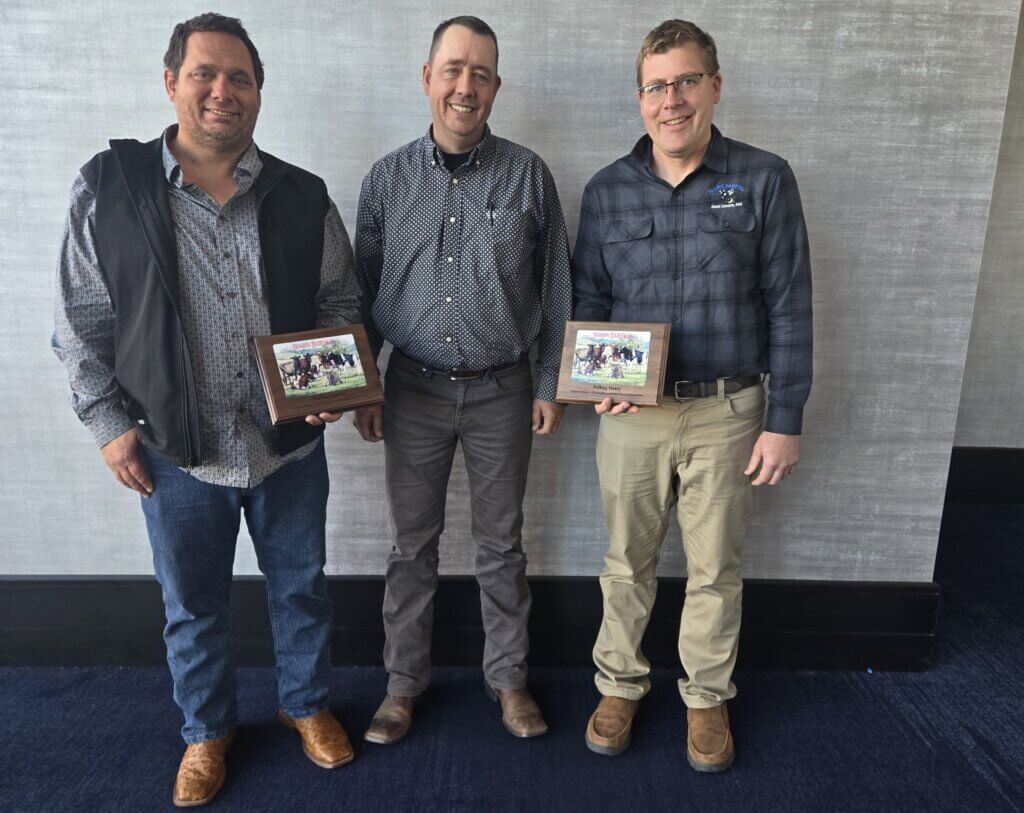
2024 Platinum Award Winners. L to R: Anthony Nunes, Wiebren Jonkman and Jason Felling
Crosswind Jerseys, Stefan Temperli, Elkton, S.D.
Nominated by Brandon Thesing, Select Sires
Diamond J Dairy, Wiebren Jonkman, Merced, Calif.
Nominated by Paul Cook, Atwater Veterinary Center
Felling Dairy, Jason and Marie Felling, Sauk Centre, Minn.
Nominated by Andrew Krause, STgenetics
NuStar Farms, Anthony and Lori Nunes, Sibley, Iowa
Nominated by Marc Etchebarne, Etchebarne Dairy Consulting, and Mark Doornink, Parnell
Ryzebol Dairy, Brant Ryzebol, Mantorville, Minn.
Nominated by Brandon Thesing, Select Sires
Windulan Holsteins, Mike, Theresa and Gina Portena, Monkton, Ont., Canada
Nominated by Ian VandenBerg, Genex Canada
Following is an excerpt from the November 2024 Hoard’s Dairyman round table discussion that highlights the Platinum winners’ reproductive management strategies. Learn about enhancing dairy cattle reproduction from these top-notch dairy producers.
Hoard’s Dairyman: Do you use sexed and/or beef semen? What about genomic testing?
Crosswind Jerseys: I run a spreadsheet every month to calculate how many sexed Jersey semen services we need from both cows and heifers to reach our heifer replacement target. We use genomic testing, so I set the Cheese Merit (CM$) limit on our females wherever I need to get the desired amount of sexed semen pregnancies every month. Any animals below that limit receive beef semen. We typically target about 95% of the heifers and 20% of the cows to receive sexed semen.
Diamond J Dairy: We genomic test all animals and use that information to determine which cows and heifers will get bred and with what. All replacement animals receive sexed semen and all other cows and heifers receive beef semen.
Felling Dairy: We use beef and sexed dairy semen on our farm. Mating decisions are made with our STgenetics representative, Andrew Krause, and the management team. We evaluate these decisions based on Net Merit (NM$), cow health and facility availability. Most recently, we started using sexed male beef semen and synchronizing our heifers. We genomic test our heifers at about 3 months of age.
NuStar Farms: We do not do any genomic testing, but we use the Select Sires Select Mating Service (SMS) to identify which cows get sexed semen or beef semen. Animals will receive sexed semen unless they are on the bottom end of the herd or are on a multiple breeding.
Ryzebol Dairy: We do not use any beef or sexed semen, and we do not genomic test.
Windulan Holsteins: We use sexed semen at first breeding in all heifers. They are all eligible. No genomic testing is completed.
Click here to read the entire Hoard’s Dairyman Round Table that features DCRC’s 2024 Platinum Award winners.
Featured Member
Editor’s Note: For each issue, DCRC interviews a member to learn more about his/her career, involvement with DCRC and thoughts about dairy cattle and reproduction.
Briza Castro
University of Wisconsin-Madison
2024 DCRC Scholar
 First and foremost, I am honored to be the 2024 Dairy Cattle Reproduction Council (DCRC) Scholar. This was my first time attending the meeting and I thoroughly enjoyed everything about it. The program provided a robust list of topics the industry currently faces along with fantastic speakers. This allowed me to present a portion of my research focused on the use of follicle-stimulating hormone (FSH) during in vivo and in vitro embryo production in dairy cattle.
My interest in bovine reproduction started during my undergraduate studies at New Mexico State University where I also worked on my master’s degree in reproductive physiology. However, I was truly exposed to dairy production when I transitioned to my current PhD program at the University of Wisconsin-Madison. My research intends to evaluate different factors influencing oocyte competence with the overall goal to improve the success of ARTs and their use in dairy cattle reproductive programs. The use of exogenous FSH during superstimulation protocols increases the number of growing follicles along with increased cumulus-oocyte complex quality and subsequent embryo quality. However, the mechanism employed resulting in this increased gamete quality remains unknown.
I would like to thank DCRC and its board of directors for putting on a remarkable meeting for industry, academia and producers. One special highlight of the meeting that sets it apart is the recognition given to dairy producers, allowing them to speak on their expertise and needs. Specifically, they discussed the methods they used to achieve effective reproductive management in their herds.
This meeting also provided great networking opportunities, with exposure to industry and academic professionals. The discussion panels, including people from both sectors, were rather insightful because they allowed us to hear from industry and academia perspectives. Although they may approach certain issues differently, both share an ultimate goal – improved reproductive efficiency. The variety of topics covered, ranging from economic issues to uterine disease, overall health, pregnancy loss and sustainability, are all relevant to dairy cattle management and reproduction. This current understanding allows for continued research of the ever-evolving dairy industry and reproductive physiology.
Overall, I had an amazing experience and I look forward to attending future meetings and continuing to be part of DCRC.
Webinar
DCRC webinar explores heat stress, gut health and their impact on animal health
“Integrating our understanding of stress physiology” headlines the Dec. 6 Dairy Cattle Reproduction Council (DCRC) webinar. The free webinar starts at 1 p.m. Central time (USA/Canada). Erin Horst, Elanco Animal Health dairy technical specialist, will serve as the instructor for this one-hour webinar.
During the webinar, Horst will explore the mechanisms by which heat stress negatively impacts intestinal integrity leading to pathogen infiltration into systemic circulation. Additionally, she will discuss how similar mechanisms can be applied across a wide variety of stressors, which have been previously explored in isolation. Lastly, Horst will share how intestinal hyperpermeability and subsequent immune activation triggers changes in energetic metabolism and innate immune function.
To register for this webinar, go to: https://bit.ly/DCRCDec6Horst. If you are a DCRC member and cannot attend the live program, you may access the webinar at www.dcrcouncil.org after Dec. 20.
Horst grew up on a small farrow-to-finish swine operation in Van Horne, Iowa. She attended Iowa State University for her bachelor’s degree in animal science. Following graduation, Horst stayed at Iowa State and completed a PhD in animal science under the direction of Lance Baumgard. Horst’s research focused on inflammation and its impact on energetic and calcium homeostasis. She has worked as a technical consultant in the dairy industry since 2020 and joined Elanco Animal Health in September of 2022.
Veterinarians may earn one Registry of Approved Continuing Education (RACE) credit for attending this DCRC webinar. To learn more about this opportunity, contact JoDee Sattler at: jodee@dcrcouncil.org.
In February, DCRC will host two webinars – “Employee training and retention,” presented by Robert Hagevoort, New Mexico State University, on Feb. 3, at 2 p.m. Central time, and “Reproductive management in the era of automation: Managing cows according to their needs,” presented by Ricardo Chebel, University of Florida, on Feb. 20, at 4 p.m. Central time. Watch your e-mail inbox to register for these webinars. More webinar information will appear in the February 2025 DCRC newsletter.
For more information about DCRC’s webinars, e-mail Caio Figueiredo, DCRC Education Committee chair, at: caio.figueiredo@wsu.edu or e-mail DCRC at: jodee@dcrcouncil.org.
Industry Calendar
- Council on Dairy Cattle Breeding Triannual Evaluation, December 3
- DCRC webinar: “Integrating our understanding of stress physiology,” December 6
- Nebraska Ag Expo, December 10-12, Lincoln, Nebraska
- Dakota Farm Show, January 7-9, Vermillion, South Dakota
- Dairy Strong Conference, January 15-16, Green Bay, Wisconsin
- National Mastitis Council Annual Meeting, January 27-30, Charlotte, North Carolina
- DCRC webinar: “Employee training and retention,” February 3
- Iowa Ag Expo, February 4-6, Des Moines, Iowa
- World Ag Expo, February 11-13, Tulare, California
- DCRC webinar: “Reproductive management in the era of automation: Managing cows according to their needs,” February 20
- Professional Dairy Producers Annual Business Conference, March 12-13, Madison, Wisconsin
- Central Plains Dairy Expo, March 25-27, Sioux Falls, South Dakota
- Dairy Calf & Heifer Association Annual Conference and Trade Show, April 8-10, Westminster, Colorado
- Precision Dairy Conference, June 17-18, Bloomington, Minnesota
