
Newsletter – 2025 – December
President's Message
 President’s Message
By Jennifer Spencer, Texas A&M AgriLife
2025-2026 DCRC President
What an incredible year we’ve had. The 2025 DCRC Annual Meeting in Middleton, Wis., brought together more than 175 dairy professionals from across the United States, Canada, and around the world. The energy, engagement, and passion for advancing dairy cattle reproduction were evident in every session, hallway conversation, and networking event. It was truly inspiring to see so many individuals, including producers, veterinarians, researchers, allied industry partners, consultants, and students, come together with a shared purpose.
Over time, DCRC has grown into much more than a place to discuss synchronization programs. Our organization now highlights a wide spectrum of topics that influence reproductive success, such as heifer development, employee training, beef-on-dairy strategies, precision technologies, and the economics behind breeding decisions. This year’s presentations reflected that evolution. We heard from leading experts about the future of IVF (in vitro fertilization), changing dairy-beef markets, reproductive technology innovations, and how to use data to build more sustainable and profitable reproductive programs.
I want to sincerely thank everyone who contributed to this successful meeting. First, my appreciation goes to Ralph Bruno for his leadership this past year. I am grateful for the work he has done to strengthen DCRC and set the stage for continued growth. I also extend my thanks to our board members for their service and guidance. Your dedication ensures that DCRC continues to be the trusted source for applied reproductive knowledge.
Other DCRC board members include newly elected Vice President Kim Egan, Genex; Secretary-Treasurer Alex Scanavez, Progressive Dairy Solutions; Past President Bruno; and director members Caio Figueiredo, Washington State University, Augusto Madureira, Michigan State University, and Mark Doornink, Parnell. Committee chairs include Awards, Kylene Anderson, Hoard’s Dairyman; Program, Paula Molinari, Genex; Education, Eduardo Oliveira, Zoetis; and Membership, Ralph Bruno. DCRC also thanks outgoing board member Tracy Burnett, University of Guelph, for her outstanding service to the organization for these past few years.
A very special thank you goes to JP Martins and Paula Molinari for developing an outstanding scientific program and coordinating our first graduate student poster competition. Congratulations again to our poster winners, Ana Laplacette (Cornell University), Iago Leão (University of Wisconsin-Madison), and Gabriela Macay (University of Florida). Their work showcased the strong future of dairy reproduction research.
We also owe tremendous appreciation to JoDee Sattler, Kristy Mach, Sue Schatz, Kyle Wieskus, Christie Nissen, and the entire DCRC team. Their organization, planning, and behind-the-scenes coordination are what make our annual meeting run smoothly. We are fortunate to have such a dedicated team supporting this organization.
To our members, thank you for your continued involvement throughout the year, whether you attend in person, join virtually, participate in webinars, or contribute to committee work. And to our sponsors, your partnership is essential. Your support allows us to deliver high-quality educational programming and resources to the dairy industry. We especially recognize our sponsors that made this conference possible. The Gold sponsors were Merck Animal Health and Select Sires. Silver sponsors included CowManager, Parnell, and Zoetis. Bronze sponsors were AHV, Datamars Livestock, Genex, Progressive Dairy Solutions, and SCCL. AHV, CowManager, DCRC, Hoard’s Dairyman, Parnell, Select Sires, and Zoetis sponsored the Excellence in Dairy Reproduction Awards.
As we look toward 2026, it’s clear that the dairy industry continues to change rapidly. Reproductive technology, data-driven decision-making, and employee development are becoming even more central to dairy success. At the same time, many other challenges linger all sectors of the dairy industry.
With the opportunities and challenges in mind, DCRC will continue to focus on connecting researchers, consultants, veterinarians, and producers. Our goal remains the same: translate science into practical, on-farm solutions that improve reproductive performance and long-term sustainability.
I am excited for our 2026 Annual Meeting in Columbus, Ohio, Nov. 10-12, where we will continue to build on the strong momentum from this year. I also welcome new members and sponsors to join us as we strengthen our impact and broaden our reach.
Serving as your president is an honor. I look forward to working with all of you over the next year as we continue to advance reproductive efficiency, support innovation, and develop the next generation of dairy professionals.
If you have ideas, feedback, or opportunities for collaboration, please don’t hesitate to reach out to me at: jennifer.spencer@ag.tamu.edu. Let’s make this another exceptional year for DCRC and for our dairy community.
Research Summaries
Delaying the induction of ovulation and using a timed artificial insemination in a Double-Ovsynch protocol increased estrus expression and altered the first-service reproductive outcomes of lactating dairy cows
A.L. Laplacette, C. Rial, E. Sitko, M.M. Perez, S. Tompkins, M.L. Stangaferro, M.J. Thomas, and J.O. Giordano.
The primary aim of this large-scale randomized controlled trial was to test whether delaying the induction of ovulation in timed artificial insemination (TAI; from the standard 56 hours to 80 hours after PGF₂α (prostaglandin) in a Double-Ovsynch protocol) could improve first-service reproductive performance in high-producing dairy cows by allowing more cows to express estrus before insemination naturally. The specific goals were: 1) increase the proportion of cows showing estrus and receiving AI at detected estrus (AIE) instead of fixed TAI; 2) determine whether this more extended proestrous period and greater estrous expression would translate into higher overall pregnancies per AI (P/AI) at first service; 3) characterize the effects of delayed ovulation induction on ovarian physiology (follicle size, luteolysis, ovulation risk, post-AI progesterone) and explain differences in fertility between cows that did or did not express estrus.
Study population and outcomes assessed
- 4,672 lactating Holstein cows (34% primiparous, 66% multiparous)
- 2 large U.S. commercial dairies
- All fitted with automated activity sensors
- Semen type for first service: sex-sorted Holstein dairy semen = 33.5% (1,564 cows); conventional beef semen = 66.5% (3,108 cows)
- Randomized at PGF₂α of Breeding-Ovsynch to:
– G56 (n = 2,338): GnRH2 (gonadotropin releasing hormone) at 56 hours → TAI 16 hours later
– G80 (n = 2,334): GnRH2 at 80 hours → TAI 16 hours later - Cows with an automated estrous alert (AEA) before scheduled GnRH2 received AIE (no GnRH)
Results
- Delayed induction (G80) increased estrous expression and AIE: 47.3% AIE (G80) vs. 12.8% AIE (G56) (P < 0.001)
- Overall first-service P/AI was similar between treatments: G80 = 61.5% vs. G56 = 62.3% (P = 0.56)
- Cows expressing estrus had higher fertility regardless of treatment: With estrus = 68.5% P/AI vs. No estrus = 56.3% P/AI (+12.2 percentage points, P < 0.001)
- In G80, cows with no estrus that received TAI had the lowest P/AI: G80 no estrus TAI = 52.8% (significantly lower than all other groups)
- Estrous cows had larger follicles, higher ovulation risk, complete luteolysis, and higher post-AI P4 in the ovarian responses compared with no estrous cows. Still, the fertility gains in estrous cows did not compensate for the significant fertility drop in non-estrous G80 cows, resulting in no net benefit from delaying GnRH2.
In conclusion, although delaying induction of ovulation substantially increased estrous expression and benefited cows that showed estrus, it exposed a larger proportion of cows with poor ovarian responses and very low fertility, resulting in no net gain in overall pregnancies per AI. The authors highlight the strategy as a predictor for identifying cows with varying fertility potential based on their expression of estrus before insemination, thereby facilitating more informed breeding decisions.
Access the paper at: https://doi.org/10.3168/jds.2024-24994
Differences in reproductive and productive performance and removal from the herd associated with time to clinical cure in dairy cows treated for metritis
F.N.S. Pereira, E.B. de Oliveira, V.R. Merenda, F.S. Lima, R.C. Chebel, K.N. Galvão, J.E.P. Santos, R.S. Bisinotto, and C.C. Figueiredo
This study aimed to evaluate the association between time to clinical cure of metritis and reproductive performance, milk production, and herd removal. The authors hypothesized that cows achieving expedited clinical cure would demonstrate better lactational performance than those with delayed cure. The importance of this study lies in the inconsistent association between antimicrobial formulation and time to clinical cure of metritis, as well as the limited literature on lactational performance differences related to time to cure. Further research is needed to determine whether cows that recover more rapidly from metritis outperform those that take longer to recover. This is particularly relevant because time to clinical cure has influenced antimicrobial use decisions and contributed to extra-label use of various antimicrobial formulations.
Study population and outcomes assessed
- This study is a retrospective cohort analysis.
- Data were collected from 3 experiments across 5 dairy herds in Florida.
- Cows diagnosed with metritis within 12 days in milk (DIM), based on fetid, watery, reddish-brown vaginal discharge (VD; n = 1,410), were treated with either ampicillin (n = 556) or ceftiofur (n = 854).
- Clinical cure was assessed visually on days 5 and 12, and categorized as clear, mucopurulent, or purulent vaginal discharge.
- Cows were grouped as CureD5 (cured by day 5; n = 705), CureD12 (cured between days 6 to 12; n = 406), NoCure (not cured by day 12; n = 299), and NoMet (no metritis diagnosis; n = 1,194).
- Data on first-service risk, pregnancy risk and hazard by 300 DIM, herd removal risk and hazard by 300 DIM, and total milk production over 10 months were collected from herd management software.
- Analyses included multivariable logistic regression, Cox proportional hazards, and ANOVA, with orthogonal contrasts used to evaluate the effects of metritis, clinical cure, and time to cure.
Results
- Treatment type did not affect the odds of cure by day 5.
- CureD5 cows had higher rates of first service (91.6% vs. 87.1%) and pregnancy by 300 DIM (69.6% vs. 62.9%), compared with CureD12 cows, although time to cure did not influence the hazard of pregnancy.
- Fewer CureD5 cows were removed from the herd by 300 DIM compared with CureD12 cows (15.5% vs. 23.7%), and CureD5 cows had a lower hazard of removal (0.61).
- Time to clinical cure did not affect milk production over 10 months.
In conclusion, these results indicate that faster clinical cure of metritis by day 5 after antimicrobial therapy is associated with improved reproductive performance and reduced herd removal, although milk yield remains unaffected. Time to cure of metritis may be a useful indicator of future performance and survivability in dairy herds, and could help guide on-farm decisions, identifying cows at greater risk for suboptimal outcomes.
Access the paper at: Differences in reproductive and productive performance and removal from the herd associated with time to clinical cure in dairy cows treated for metritis
Impact of intramammary infections on mammary gland development in pregnant dairy heifers during late gestation
M.X.S. Oliveira, C.S. Gammariello, P.H. Baker, K.M. Enger, S.K. Jacobi, and B.D. Enger
Intramammary infections (IMI) are common in nonlactating dairy cattle and are known to disrupt mammary tissue architecture in nonpregnant heifers, but their impact on mammary development during pregnancy is not well understood. The objectives of this study were to: 1) evaluate how Staphylococcus aureus IMI affects mammary secretion somatic cell count (SCC) and differential cell counts; 2) assess immune cell infiltration in the developing mammary gland tissues of pregnant dairy heifers at different stages of late gestation; and 3) determine whether IMI induces architectural changes in mammary tissue as measured by histomorphometry. The authors hypothesized that IMI would impair mammary development by restricting epithelial tissue expansion and delaying stromal tissue regression.
Study population and outcomes assessed
- 21 pregnant Holstein heifers were selected from the Ohio State University Farm.
- Heifers were enrolled at 3 gestational ages (~5.75, 6.75, and 7.75 months; 180 ± 2, 208 ± 2, and 238 ± 2 days of pregnancy).
- Using a contralateral quarter-pair design, one culture-negative quarter of each heifer received a saline infusion (SAL), and the opposite quarter was challenged with 5,000 CFU of Staphylococcus aureus (CHALL).
- Mammary secretions were collected at multiple time points until tissue harvest 21 days post-challenge, when heifers were 6.5, 7.5, or 8.5 months pregnant.
- Tissue samples from central and edge parenchymal regions were analyzed for immune cell infiltration and morphometric changes.
Results
- Staphylococcus aureus infusion established IMI in all challenged quarters that lasted the study duration; all SAL quarters remained bacteriologically negative throughout.
- Secretions from CHALL quarters exhibited higher SCC and a greater proportion of neutrophils than SAL quarters.
- CHALL tissues showed increased immune cell infiltration in both luminal and intralobular stromal regions, and lower secretion scores, independent of gestational age. Across treatments, heifers at later gestational stages had reduced adipose tissue area and larger lobular areas.
- In 7.5-month heifers, CHALL quarters also exhibited reduced epithelial area and increased intralobular stromal area in the central region.
- At 8.5 months of pregnancy, luminal areas in edge regions of CHALL quarters were nearly 50% smaller than in SAL quarters.
- Lobular, adipose, and extralobular stromal areas showed minimal differences between CHALL and SAL quarters.
In conclusion, overall, these findings demonstrate that IMI causes structural damage to the mammary gland in pregnant heifers, with more pronounced effects during late gestation. Tissue from mammary glands with IMI may have failed to reach full maturity compared with their uninfected counterparts, suggesting a potential limitation in milk accumulation and secretory capacity.
Access the paper at: Impact of intramammary infections on mammary gland development in pregnant dairy heifers during late gestation
Featured Column
DCRC Excellence in Dairy Reproduction Platinum winners share breeding strategies
The 2025 Dairy Cattle Reproduction Council (DCRC) Annual Meeting featured recognition of DCRC’s Excellence in Dairy Reproduction Award winners. DCRC honored 24 exceptional dairy operations as Bronze, Gold, Silver, or Platinum winners. DCRC extends a huge congratulations to the Platinum winners!
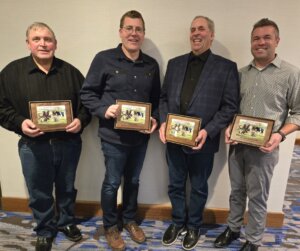
Platinum award winners L to R: Torry Swiggum, Cottonwood Dairy, Jason Felling, Felling Dairy, John Proskine, Pleasant View Farms, Tyler Hendriks, Hendriks Dairy
Cottonwood Dairy LLC, J. Winn, B. Larson, R. Larson, South Wayne, Wis.
Nominated by Eric Zwiefelhofer, STgenetics
Felling Dairy, Jason and Marie Felling, Sauk Centre, Minn.
Nominated by Andrew Krause, STgenetics
Hendriks Dairies Ltd., Tyler Hendriks, Brucefield, Ont.
Nominated by Gary Markus, Alta Genetics
Mar-Bec Dairy, Marty and Becky Hallock, Mondovi, Wis.
Nominated by Pete Weber, Genex
Pleasant View Farms Inc., Rodney Metzler, Martinsburg, Pa.
Nominated by Benjamin Giese, Genex
Schumacher Farms of Elgin Inc., Kurt and Trisha Schumacher, Elgin, Minn.
Nominated by Megan Weisenbeck, Northern Valley Livestock Services
Following is an excerpt from the November 2025 Hoard’s Dairyman round table discussion that highlights the Platinum winners’ reproductive management strategies. Learn about enhancing dairy cattle reproduction from these top-notch dairy producers.
Hoard’s Dairyman: Describe how you select fertility traits.
Cottonwood: Fertility traits are one of our highest priorities when selecting sires and which cows to breed to Holstein for replacements.
Felling: Our genetics team provider pulls information and reviews results with us quarterly. Traits we focus on are always changing slightly, but cow health, not too large of a cow, and low mastitis are a few priority traits.
Hendriks: While we do pay attention to daughter pregnancy rate (DPR), cow conception rate (CCR), and heifer conception rate (HCR), the main health metric we look at is productive life (PL). We feel this captures the main health traits we are looking for in our herd, instead of being focused on one trait with low heritability. Our herd will select the top lifetime net merit bulls (NM$) available sexed and then begin our sub-sort to ensure we are meeting our PL and milk or combined fat and protein (CFP) targets. We avoid any bull with a strong PL but extreme negatives for fertility.
Mar-Bec: We have a high emphasis and are big believers in DPR and PL. Besides milk and components, these are our focus traits. Cows, if not bred by 250 days in milk (DIM) or after six breedings, are marked as “do not breeds” (DNB). Bulls’ conception rates are monitored for low settling. If needed, sires are removed as soon as possible.
Pleasant View: Our number one selection is conception; every other trait will follow. Our priority is inseminating the cow. We let our genetics provider make sure all other traits are covered.
Schumacher: We use high-ranking herd health profit index (HHP$), dairy wellness profit index (DWP$), total performance index (TPI), and cheese merit (CM$) bulls, and try to stay plus on DPR, CCR, HCR, and fertility index on all sires along with individual sire fertility, somatic cell score (SCS), mastitis, and other health traits.
Hoard’s Dairyman: Describe your breeding program.
Cottonwood: We have an in-house breeder, Fernando, who is our main breeder. He does everything, including training relief breeders to breed when he is not available.
Felling: Our breeding is done by an in-house team of primarily five individuals. We train within and with our genetics provider as needed. The breeding team takes a high level of pride in their responsibilities and holds each other accountable. Weekly, we monitor team and individual breeding results. We ensure compliance by reviewing results, completing the timed shots on time, and having all needed supplies on hand.
Hendriks: Breeding is all done by our genetics provider and technician performance is reviewed quarterly. Hormone shots are all done by our team member, Tyler, with the night milking shift occasionally giving the nighttime gonadotropin releasing hormone (GnRH) shots in the Double Ovsynch program. Importance of correct dose and to the right cows is often explained, and there is clear communication if a cow gets missed.
Mar-Bec: Our team member, Tim, does 90% of the breeding and hormone administration. Other team members, Marty and Robin, provide relief. Conception rates are monitored and training is provided on an as-needed basis.
Pleasant View: Our total breeding program is done by our employee team. Our genetics provider does refresher classes every six months and trains any new team members. John Proskine, herd manager, monitors everyone to make sure hormones are administered accurately and timely. Our herd veterinarian, Rodney Bachtell, helps train and educate for herd health. Andy Austin from Cargill helps train and monitor DairyComp 305 records.
Schumacher: Lactating cows are bred by our herd manager and Select Sires technicians. Alta Genetics technicians breed heifers at our heifer grower. Training for those administering cow hormones is to work alongside someone who is experienced with the protocol from the dairy. When needed, breeding training or retraining is done by Select Sires artificial insemination (AI) trainers.
Featured Member
Editor’s Note: For each issue, DCRC interviews a member to learn more about his/her career, involvement with DCRC and thoughts about dairy cattle and reproduction.
Ana Laura Laplacette
Cornell University
2025 DCRC Scholar
Every year since I began my graduate program, I have looked forward to and attended the Dairy Cattle Reproduction Council (DCRC) Annual Meeting, because it offers a valuable opportunity to learn from experts in the field and to share our research updates with producers, veterinarians, fellow researchers, and key members of the dairy industry. This year’s meeting took place in Middleton, Wis., and it was no exception. The DCRC organized an exceptional program and attendance was excellent, which made the conference a truly enriching experience. For me, this year carried special significance because I was honored to be selected as the 2025 DCRC Scholar.

Ana Laplacette
The meeting featured a series of talks delivered by outstanding speakers covering diverse topics, including reproductive programs for non-lactating heifers, cow longevity, exit dynamics and decision-making, the use of beef-on-dairy, tools to evaluate reproductive performance, use of sensor technologies for monitoring health and reproduction, among others. In addition, plenary sessions addressed important and stimulating subjects that initiated great discussions, such as the impact of beef-on-dairy from the perspective of a beef consultant, the future of reproductive technologies beyond in vitro fertilization, and an overview and projection of the dairy industry.
I am a PhD student in the Dairy Cattle Biology and Management Laboratory at Cornell University, under the supervision of Julio Giordano. My current research focuses on developing targeted reproductive management programs to improve whole-herd first-service management and performance. A key step in developing these programs is grouping cows with similar reproductive potential, using predictors to tailor management strategies. This area of research integrates multiple concepts of dairy cattle biology, herd management, and data analytics. Therefore, attending a meeting with such a broad lineup of relevant topics and strong participation was an amazing opportunity to engage with the academic community and connect with the ultimate users of the management strategies we develop through research.
Poster sessions provided a great opportunity to learn about new research and updates presented by graduate students. In these sessions, I was able to present two projects from my PhD research: one focused on predicting first-service pregnancy outcomes in lactating dairy cows using machine-learning algorithms trained on behavioral, performance, and cow-feature data; the other explored combining early-lactation automated estrous alerts with predictors of reproductive performance to group cows based on first-service reproductive potential. The discussions and exchanges with other presenters and attendees were truly enlightening.
A highlight of the meeting was the ceremony for the Excellence in Dairy Cattle Reproduction Awards, followed by a panel discussion with the dairy producers selected to receive the award. This award recognizes producers who successfully implement management procedures and achieve high reproductive efficiency. It was great to hear the producers share insights about their operations, management practices, challenges, and strengths. In addition, a poster presented by DCRC officers and Hoard’s Dairyman magazine summarized reproductive outcomes for herds that had received the award in previous years.
As part of the experience, I also had the opportunity to participate in the farm tours organized by DCRC. I enjoyed visiting the University of Wisconsin Arlington Agricultural Research Station, Maier Farms, and Blue Star Dairy. At each stop, we were warmly welcomed and guided through the facilities while learning about the reproductive management programs implemented and their performance.
Overall, the DCRC Annual Meeting was a wonderful experience that allowed me to expand my knowledge and strengthen my connections in the field of dairy cattle reproduction. I would like to once again thank the DCRC Scholars Program for giving me the opportunity to attend and I look forward to participating in future meetings.
Industry Calendar
- Council on Dairy Cattle Breeding Triannual Evaluation, December 2
- 4th International Precision Dairy Farming Conference, December 3-5, Christchurch, New Zealand
- Dairy Strong Conference, January 14-15, Green Bay, Wisconsin
- DCRC Webinar with Anna Denicol, January 20
- NMC Annual Meeting, January 26-29, Birmingham, Alabama
- DCRC Webinar (presented in Spanish) with Victor Cabrera, February 4
- DCRC Webinar with Fabio Lima, March 12
- World Ag Expo, February 10-12, Tulare, California
- Professional Dairy Producers Business Conference, March 4-5, Madison, Wisconsin
- Central Plains Dairy Expo, March 17-19, Sioux Falls, South Dakota
- Council on Dairy Cattle Breeding Triannual Evaluation, April 7
- Dairy Calf & Heifer Association Annual Conference and Trade Show, April 7-9, Tucson, Arizona
- NMC Regional Meeting, June 16-18, Green Bay, Wisconsin
- Council on Dairy Cattle Breeding Triannual Evaluation, August 11
- Dairy Cattle Reproduction Council Annual Meeting, November 10-12, Columbus, Ohio
- Council on Dairy Cattle Breeding Triannual Evaluation, December 1
