
Newsletter – 2026 – April
President's Message
 President’s Message
By Jennifer Spencer, Texas A&M AgriLife
2025-2026 DCRC President
As we move further into 2026, I continue to be encouraged by the level of engagement, collaboration, and innovation occurring across the dairy industry. One recent example of this momentum was the 2026 High Plains Dairy Conference (HPDC), held March 3-4 in Amarillo, Texas, which brought together more than 500 dairy producers, veterinarians, consultants, allied industry partners, and academics from across the region.
HPDC continues to serve as one of the premier educational and networking events in the dairy industry, offering a platform for stakeholders to discuss emerging challenges, research advancements, and practical management strategies. As a co-chair of this year’s conference, it was incredibly rewarding to see the strong participation and meaningful conversations taking place both in and outside of the meeting rooms.
A consistent theme throughout the conference was the increasing complexity of dairy management, particularly as it relates to reproduction, workforce development, and resource management. The DCRC pre-conference session provided a focused look at how reproductive management is evolving to meet these challenges through both science and application.
The session opened with a presentation on targeted reproductive management by Ricardo Chebel, University of Florida, emphasizing the importance of tailoring reproductive strategies to individual cows and herd-level goals, rather than relying on uniform protocols. This approach highlights how variability in cow health, production level, and physiology can influence reproductive outcomes and the need for more precise, intentional decision-making.
Building on that concept, Caio Gamarra, Merck Animal Health, discussed the effective use of available herd data, demonstrating how producers can better leverage existing data streams to improve reproductive performance. This included practical strategies for interpreting reproductive metrics, identifying bottlenecks, and using data to guide breeding decisions more efficiently.
The final presentation of the DCRC pre-conference, delivered by Gustavo Schuenemann, The Ohio State University, explored the hidden drivers of reproduction, milk production, and cow longevity – reinforcing the interconnected nature of management, nutrition, and reproduction. This talk highlighted how management decisions made early in lactation and throughout the production cycle can have lasting impacts on reproductive success and overall herd performance.
Collectively, these presentations reinforced a central message: reproductive success is no longer driven by single-factor solutions. Instead, reproductive success is driven by integrated, data-informed management strategies. The discussions aligned closely with broader conference themes, which emphasized precision technologies, analytics, and whole-system approaches to dairy management.
Another key topic shaping reproductive strategies is the role of beef-on-dairy breeding, which was further explored during panel discussions. Producers are increasingly working to maximize the value of crossbred calves while carefully balancing replacement heifer inventories and long-term herd goals. At the same time, conversations around right-sizing heifer inventories highlighted the importance of strategic reproductive planning in an environment where replacement numbers remain constrained.
Beyond reproduction, broader industry challenges were also front and center. Workforce availability and employee training remain critical concerns, with producers actively seeking strategies to recruit, retain, and develop skilled labor. In parallel, sessions addressing water scarcity, forage management, and sustainability emphasized the importance of adapting production systems to regional resource limitations while maintaining productivity and animal health.
The conference also highlighted the essential role of innovation and technology, from camera-based monitoring systems to advancements in nutrition and metabolic management. These tools are becoming increasingly integrated into dairy operations and are playing a key role in improving efficiency, reproductive performance, decision-making, and overall herd performance.
Equally important was the continued focus on developing the next generation of dairy professionals. The student poster competition and networking opportunities provided valuable platforms for students to share their research and connect with industry leaders. These efforts are critical to ensuring the long-term success and sustainability of our industry.
As we reflect on these discussions, it is clear that the dairy industry is evolving rapidly. Reproductive management is no longer a standalone component of herd management; it is deeply interconnected with economics, labor, technology, and sustainability. At DCRC, our mission remains to bridge science and application by providing producers, veterinarians, consultants, and industry partners with the knowledge and tools needed to make informed, strategic decisions.
I encourage you to stay engaged with DCRC throughout the year through our webinars, resources, and upcoming events. Our goal is to continue fostering collaboration, advancing reproductive efficiency, and supporting innovation across all sectors of the dairy industry.
Serving as your president is an honor and I look forward to working alongside all of you as we continue to strengthen the future of dairy reproduction.
Research Summaries
Effect of timing of artificial insemination with conventional or sex-sorted semen on fertility of lactating dairy cows
V.G. Santos, P.D. Carvalho, A.H. Souza, S. Priskas, J.A.L. Castro, A.M.F. Pereira, P.J. Ross, J. Moreno, M.C. Wiltbank, and P.M. Fricke
The primary aim of this study was to evaluate the effect of insemination timing on pregnancy per artificial insemination (P/AI) in lactating dairy cows using conventional or sex-sorted semen. The research analyzed timing relative to ovulation induction in timed AI (TAI) protocols and relative to the onset of estrous alerts in estrous-based AI, across three experiments. This addresses optimization of AI timing to improve fertility, particularly with sex-sorted semen.
Study population and outcomes assessed
- 1 TAI 16 hours after last gonadotropin-releasing hormone (GnRH) or at 0 hour: multiparous Holstein cows in 6 herds, Double-Ovsynch for the first service using conventional semen (n=1,924).
- 2 TAI from 13-23 hours after last GnRH: Holstein cows in 2 herds, Double-Ovsynch for the first TAI; GGPPG (presynchronization with GnRH followed by an Ovsynch protocol with a second PGF2α treatment) for the second and subsequent TAI; AI with conventional beef (n=8,253) or with sex-sorted semen (n=6,813).
- 3 AI timing from 0-40 hours after estrous alert: lactating cows were AI after estrous alert using activity monitors, with conventional beef (n=7,266) or with sex-sorted dairy semen (n=5,436).
Key outcomes
P/AI at 32 days post-AI via ultrasound or confirmation, with timing intervals from last GnRH to TAI (0 to 16 hours), (13-23 hours), or estrous alert onset to AI (0-40 hours), and statistical effects (linear/quadratic) by semen type.
Results
- In Exp. 1, Ovsynch-56 cows (TAI 16 hours after last GnRH) had greater P/AI than Cosynch-56 cows (TAI at 0 hour): 46% (472/1,026) vs. 36% (323/898; P<0.01).
- In Exp. 2, TAI from 13-23 hours after last GnRH showed no linear or quadratic effect on P/AI for sex-sorted Holstein (P=0.54/0.43) or conventional beef semen (P=0.35/0.30), with overall P/AI of 43.0% (8,995/20,895).
- In Exp. 3, AI timing from 0-40 hours after estrous alert onset had linear (P<0.01) and quadratic (P<0.01) effects on P/AI for both semen types, with lower P/AI for ≤3 hours or ≥24 hours vs. 13-23 hours. The overall P/AI was 48.1% (9,851/20,461), with no difference in optimal timing between semen types. For conventional semen, the P/AI was lower early (0-2 hours: 38%) or late (>23 hours: 44%) vs. optimal (15-16 hours: 49%; P<0.01), with no effect in the 13- to 23-hour range (linear P=0.14, quadratic P=0.13). Similar to sex-sorted semen, the P/AI was lower early (0-2 hours: 37%) or late (>23 hours: 42%) vs. optimal (15-16 hours: 54%; P<0.01), with no effect on the 13- to 23-hour range (linear P=0.26, quadratic P=0.19).
In conclusion, lactating dairy cows inseminated too early relative to a synchronized ovulation or too early or too late relative to the onset of estrous alert had reduced fertility. The authors concluded that precise timing is critical for maximizing P/AI, especially when using sex-sorted semen in commercial dairy operations, with optimal AI timing of 13 to 23 hours after the last GnRH treatment or onset of estrous alert yielding the highest P/AI (e.g., 49-54% at 15-16 hours vs. 37-44% outside this range). Refinements in synchronization protocols, estrous detection accuracy, and AI scheduling are recommended to enhance reproductive efficiency.
Access the paper at: https://doi.org/10.3168/jds.2025-26428
Economic effects of automated health monitoring based on sensors versus visual observation for dairy cows in early lactation
Rial, M.L. Stangaferro, M.J. Thomas, and J.O. Giordano
Optimizing health monitoring strategies in early lactation can influence both the productivity and economic outcomes of dairy herds. This study aimed to compare the economic impact, specifically cash flow, of two health monitoring approaches for lactating Holstein cows: one relying exclusively on automated health alerts and the other relying on visual observation to select cows for clinical examination during the first 3 to 21 days in milk (DIM). The authors hypothesized that the automated health monitoring approach would increase early lactation milk yield and overall cash flow, despite potentially higher health monitoring and treatment costs.
Study population and outcomes assessed
A total of 1,192 lactating Holstein cows were enrolled in a randomized controlled trial. Each cow was fitted with a neck-mounted automated rumination and activity monitoring system (SenseHub, Merck Animal Intelligence) and had milk weights recorded automatically at each milking (MM27BC, DeLaval). Cows were randomly assigned to either visual observation (VO, n=594) or automated health monitoring (AHM, n=598).
- VO group: Cows selected for clinical examination based solely on visible clinical signs of disease.
- AHM group: Cows selected for clinical examination based on automated alerts, including health index score <86, daily rumination <250 minutes, or a >20% reduction in daily milk yield.
Outcomes included milk yield, health events, herd exit, and associated costs (health monitoring, treatment, replacement, and income over feed costs). Cash flow per cow and per stall up to 100 DIM were estimated using deterministic linear models and stochastic analysis.
Results
- Cash flow analyses consistently favored the AHM group, regardless of whether cows that remained, exited, or all cows combined were considered.
- Deterministic models indicated higher cash flow for AHM cows, while stochastic simulations supported that AHM was more likely to result in positive economic outcomes compared with VO.
- The magnitude of the difference between groups was influenced by herd performance, herd exit dynamics, input and output prices, and the cash flow estimation method.
In conclusion, implementing an early lactation health monitoring program that relies exclusively on automated alerts for selecting cows for clinical examination is economically advantageous compared with a program based solely on visual observation. Automated monitoring can enhance cash flow while supporting herd health management.
Access the paper at: Economic effects of automated health monitoring based on sensors versus visual observation for dairy cows in early lactation – Journal of Dairy Science
Modeling heat stress effects on first service to conception rates in Canadian Holstein dairy cattle
G.R. Dodd, F. Miglior, F.S. Schenkel, I.L. Campos, R.E. Jahnel, and C.F. Baes
Heat stress (HS) negatively affects production and fertility in dairy cattle, but the exact point at which heat load begins to impair reproductive performance is not well defined. This study aimed to estimate the temperature-humidity index (THI) threshold at which the interval from first service to conception (FSTC) begins to increase due to HS, evaluate the effect of estrous synchronization on that threshold, and identify high-risk geographic regions for Canadian dairy farming.
Study population and outcomes assessed
- The study analyzed 2,033,928 FSTC records from 1,239,053 Canadian Holstein cows (parities 1-3), collected between November 2008 and April 2022.
- Hourly ambient temperature and relative humidity were obtained from the NASA Prediction of Worldwide Energy Resources (POWER) database and daily THI was calculated.
Daily THI was averaged across 3 temporal windows relevant for follicular growth and zygotic survival:
- 3 days before to 2 days after first insemination
- 7 days before to 2 days after first insemination
- 10 days before to 2 days after first insemination
A repeatability model was used to adjust FSTC for environmental and genetic effects. Segmented linear regressions were used to determine the THI threshold at which FSTC begins to increase.
Results
- The HS threshold ranged from THI 65 to 68.6, depending on parity and time window.
- The most accurate window is 3 days before to 2 days after first insemination, and the average threshold of THI 66 for this window was selected as the representative onset of HS effects on FSTC.
- Above THI 66, FSTC increased, indicating reduced fertility.
- Timed artificial insemination (AI) protocols were more sensitive to HS, with effects starting at a THI of 64 and FSTC increasing by 0.44 day above this threshold.
- Heat detection had a higher heat stress threshold (THI 72.8), but FSTC increased more sharply by 3.27 days above the THI threshold.
- Geographic analysis identified Ontario as the highest-risk region, with average summer THI exceeding 66 and about 50% of daily hours and summer days above this threshold. All provinces except British Columbia experienced their hottest season within the last four years.
In conclusion, heat stress significantly increases the interval from first service to conception in Canadian Holstein cattle, with effects beginning at approximately THI 66. A genetic analysis is needed to evaluate a possible genotype by environment interaction and the corresponding re-ranking of sires.
Access the paper at: Modeling heat stress effects on first service to conception rates in Canadian Holstein dairy cattle
Featured Column
Consider these management strategies to improve heifer growth and reproduction
Turn back the calendar 10 years. Did you predict today’s high use of sexed and beef semen on dairy heifers and cows? Did you predict today’s high value on dairy heifers and beef animals? Probably not.
Regardless, you don’t want to “leave money on the table” when managing heifers. During the 2025 Dairy Cattle Reproduction Council (DCRC) Annual Meeting, Paul Fricke, University of Wisconsin-Madison, noted that as reproductive performance of lactating dairy cows markedly improved (compared to what the industry faced just two decades ago), replacement heifer inventories increased and thus heifers’ value dropped. And in general, dairy bull calves were unwanted; feedlots and slaughterhouses found them undesirable.
Dairy producers met these challenges by implementing inventory management strategies to right-size replacement heifer inventories. Basically, they used sexed semen (usually on higher genetic cattle), which boosted genetic progress, and beef semen (usually on lower genetic and/or less fertile cattle). Concurrently, the U.S. beef herd decreased – resulting in higher prices. Dairy producers responded by inseminating more dairy cows and heifers to beef semen. The result? Today’s dairy heifer replacement herd is tight and individual heifers carry high value.
Given the rapidly shifting economic forces in the U.S. dairy and beef markets, Fricke’s laboratory explored management strategies to improve heifer growth and reproduction by reviewing several recent studies
Evaluating insemination eligibility and repro performance
The association between insemination eligibility and reproductive performance of nulliparous heifers on subsequent body weight and milk production of primiparous Holstein cows (Lauber et al., 2023) looked at the association between insemination eligibility and reproductive performance of nulliparous heifers with subsequent body weight (BW) at 30 days in milk (DIM) and milk production at weeks 4, 8, and 12 of lactation of primiparous cows. Nulliparous heifers were eligible for first insemination at 380 days of age and were inseminated, based on detection of estrus, with sexed semen. The herd’s mean mature body weight (MBW) was 686.2 ± 19.3 kg (1,512.8 ± 42.6 pounds). Cows fell into one of four quartiles: Q1 (lightest), Q2 (light-moderate), Q3 (moderate), and Q4 (heaviest).
The predicted transmitting ability (PTA) values for daughter pregnancy rate (DPR) and heifer conception rate (HCR) differed (P <0.001) among quartiles, with Q1 cows having greater genetic potential for DPR and HCR than Q4 cows. Veronese et al. (2019) reported negative correlations between genomic DPR and HCR with genomic milk yield in Holstein heifers. Parent average (Kuhn et al., 2006) and genomic merit (Veronese et al., 2019) for DPR were positively associated with pregnancies/artificial insemination (P/AI) at first insemination in nulliparous heifers. Furthermore, genomic merit for HCR and DPR tends to be positively associated with the hazard of pregnancy and estrus, respectively, in nulliparous heifers (Veronese et al., 2019).
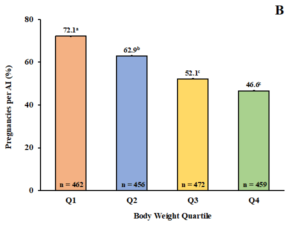
Body weight quartile was associated (P <0.001) with P/AI at first service as nulliparous heifers with Q1 cows having approximately 9 to 26 percentage points more P/AI at first insemination as heifers than Q2, Q3, and Q4 cows (Figure 1). By conceiving and calving approximately 20 days earlier than Q4 cows, Q1 cows had fewer days on feed. Thus, they had a shorter growth period as heifers, before beginning first lactation to achieve ≥85% MBW post-calving. By contrast, more than half of Q4 cows failed to conceive at first insemination when they were heifers, thereby allowing for one or more estrous cycles to grow before conceiving at a later insemination. Because heifers were eligible for first insemination primarily based on age, separating heifers into weight quartiles was largely due to differences in genetic merit for fertility traits among heifers. Thus, insemination eligibility and reproductive performance of heifers and genetic potential for body size and fertility traits were all associated with heifer growth.
Figure 1. Pregnancies per AI (P/AI; %) at first insemination as heifers after detection of estrus and AI with sexed semen by body weight (BW) quartile (Q1-Q4) at 30 DIM as primiparous cows. Percentages with different lowercase superscripts differ (P ≤ 0.05). Adapted from Lauber et al., 2023
Use 5-day CIDR Synch protocol
Comparison of reproductive management programs for submission of Holstein heifers for first insemination with conventional or sexed semen based on expression of estrus, pregnancy outcomes, and cost per pregnancy (Lauber et al., 2021) confirms DCRC’s recommendation to use the 5-day controlled intravaginal progesterone insert (CIDR) Synch protocol (rather than OvSynch) in dairy heifers. With nulliparous heifers often carrying the highest genetics (and potentially greater fertility) in a herd, producers often choose sexed semen for several in this group. Yet, sexed semen tends to be less fertile than conventional semen. The fertility gap nearly closes when inseminating via timed artificial insemination (TAI) after using the 5-day CIDR-Synch protocol.
Fricke’s research team conducted two field trials to compare reproductive management programs for submission of Holstein heifers for first insemination. In Experiment 1, nulliparous Holstein heifers were submitted to a 5-day PRID- (progesterone-releasing intravaginal device) Synch protocol (day 0, GnRH + PRID; day 5, PGF2a -PRID; day 6, PGF2a; day 8, GnRH + TAI) and randomly assigned for PRID removal on day 5 or day 6, followed by TAI with conventional semen. Delaying PRID removal decreased early expression of estrus before scheduled TAI (0.9% vs. 12.2%) and P/AI did not differ between treatments. Thus, removing the P4 insert 24 hours later suppressed early expression of estrus during the protocol without affecting fertility when heifers were inseminated with conventional semen.
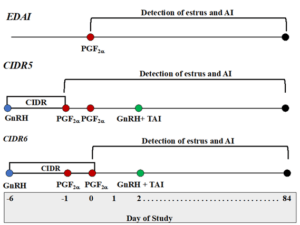
Refer to Figure 2 for Experiment 2’s design. Nulliparous Holstein heifers were randomized within each of the three farms to one of three treatments for first AI with sexed: 1) CIDR5, 2) CIDR6, and 3) estrous detection and AI after detection of estrus (EDAI; PGF2α on day 0 followed by once daily detection of estrus and AI). The control treatment – a single PGF2α treatment administered on day 0 – represented how many farms manage dairy heifers for first insemination. Comparing the CIDR5 and CIDR6 treatments was based on an experiment using conventional semen in which delaying progesterone insert removal decreased early expression of estrus before scheduled TAI. This resulted in no difference in P/AI (Lauber et al., 2021).
Similar to Experiment 1, delaying CIDR removal decreased early expression of estrus before scheduled TAI (0.004% vs. 27.8%). However, CIDR5 heifers tended to have more P/AI at 35 ± 5 and 64 ± 5 days after AI than CIDR6 and EDAI heifers, respectively, when heifers were inseminated with sexed semen. Overall, CIDR5 and CIDR6 heifers had fewer days to first AI and pregnancy than EDAI heifers.
Figure 2. Schematic diagram of reproductive protocols. Holstein heifers were randomized to receive TAI after a 5-day CIDR-Synch protocol (CIDR5), a 6-day CIDR-Synch protocol (CIDR6), or treatment with PGF2α on day 0 and once-daily AI after estrus (EDAI). Adapted from Lauber et al., 2021
Comparing costs of treatments
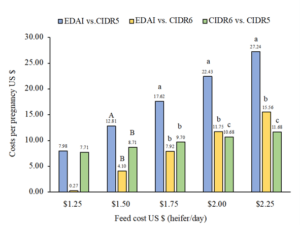
Researchers conducting this study ran a partial budget analysis based on actual farm costs. They determined the cost per pregnancy for heifers in each treatment during the 84-day breeding period. Expenses used to calculate the cost per pregnancy for each heifer included hormonal treatment, detection of estrus, semen and AI, pregnancy diagnosis, and feed costs. Labor associated with treatments and detection of estrus was $13/hour and hormones for ovulation synchronization or estrous induction were $1.60, $2.06, and $12.27 per GnRH treatment, PGF2α treatment, and CIDR insert, respectively. Also, they conducted a sensitivity analysis to determine the effect of varying feed costs on total costs per pregnancy to reflect differences in costs per pregnancy due to market conditions or geographical regions (Figure 3). The researchers found that costs per pregnancy were less for CIDR5 than EDAI heifers when the daily feed cost exceeded $1.50 per heifer per day.
In conclusion, although delaying CIDR removal by 24 hours within a 5-day CIDR-Synch protocol suppressed early expression of estrus before TAI, delaying CIDR removal by 24 hours did not affect fertility when heifers were inseminated with conventional semen (Experiment 1), whereas P/AI tended to decrease for the 6-day CIDR-Synch protocol for heifers inseminated with sexed semen. Furthermore, submitting heifers to a 5-day CIDR-Synch protocol for first AI tended to increase P/AI and decrease the cost per pregnancy compared to EDAI heifers
Figure 3. Sensitivity analysis of feed cost (US$/heifer/day) on cost per pregnancy. All other input costs in the analysis were held constant among treatments. Means with different lowercase letters (a-c) differ (P < 0.05), whereas means with different capital letters (A-B) tended to differ (P < 0.10). Adapted from Lauber et al., 2021
For more details, read Fricke and Lauber’s DCRC Annual Meeting proceedings paper, found in the DCRC Member Center.
Featured Member
Editor’s Note: For each issue, DCRC interviews a member to learn more about his/her career, involvement with DCRC and thoughts about dairy cattle and reproduction.
Caio Figueiredo
Washington State University
DCRC Member since 2019

Caio Figueiredo
A former Dairy Cattle Reproduction Council (DCRC) Education Committee chair and now a DCRC board member, meet Caio Figueiredo, an assistant professor of veterinary clinical sciences in the College of Veterinary Medicine at Washington State University (WSU). He grew up in São Paulo City, Brazil – one of the largest urban centers in the world. Figueiredo had limited exposure to livestock or dairy production prior to starting veterinary school.
“My involvement with dairy cattle began during veterinary training and expanded significantly after I moved to the United States,” Figueiredo explained. “Since then, my professional work has been primarily focused on dairy production systems and dairy cattle health and reproduction.”
At WSU, Figueiredo’s work centers on veterinary medicine extension and research/scholarship activities. “My work focuses on supporting dairy producers and veterinarians through applied research, outreach, and educational programming, aimed at improving dairy cattle health and reproductive performance,” he said.
Figueiredo’s interest in dairy cattle reproduction stems from reproduction being one of the most complex and integrative aspects of dairy production. “Reproductive success is foundational to dairy system sustainability,” he stated. “It depends on the alignment of multiple factors, including nutrition, health, welfare, management, and environment. The multifactorial nature of reproductive performance makes it both challenging and intellectually engaging. Furthermore, it offers meaningful opportunities to improve herd productivity and animal well-being.”
As the primary source of information and technology regarding reproductive management, DCRC provides several educational opportunities. Figueiredo has immensely benefited from DCRC programming and online resources. He explained, “Through DCRC events and communications, I have gained a deeper appreciation for the biological and management complexity underlying dairy cattle reproduction. Additionally, I have learned about a wide range of practical tools and strategies that can be used to assess, monitor, and improve reproductive performance across diverse dairy production systems.”
While great strides in reproductive efficiency have been made during DCRC’s 20-year existence, Figueiredo noted some of the most significant reproductive challenges that face the dairy industry today. He listed management of health disorders that impair reproductive performance and the need for more precise and data-driven reproductive monitoring tools as today’s top repro challenges. “In addition, heat stress, labor constraints, and the increasing complexity of dairy operations require reproductive programs that are both biologically sound and operationally feasible,” he remarked. “Continued integration of technology, herd health management, and reproductive strategies will be essential to improving outcomes across modern dairy systems.”
Industry Calendar
- Council on Dairy Cattle Breeding Triannual Evaluation, April 7
- Dairy Calf & Heifer Association Annual Conference and Trade Show, April 7-9, Tucson, Arizona
- Tri-State Dairy Nutrition Conference, April 13-15, Fort Wayne, Indiana
- Animal Agriculture Alliance Stakeholders Summit, May 5-7, St. Louis, Missouri
- II International Scientific Meeting on Colostrum, May 20-23, Guelph, Ontario, Canada
- NMC Regional Meeting, June 16-18, Green Bay, Wisconsin
- American Dairy Science Association Annual Meeting, June 21-24, Milwaukee, Wisconsin
- Holstein Association USA National Convention, June 22-25, Orlando, Florida
- Council on Dairy Cattle Breeding Triannual Evaluation, August 11
- World Dairy Expo, September 29-October 2, Madison, Wisconsin
- Dairy Cattle Reproduction Council Annual Meeting, November 10-12, Columbus, Ohio
- Council on Dairy Cattle Breeding Triannual Evaluation, December 1
- NMC Annual Meeting, January 25-28, Jacksonville, Florida
- World Ag Expo, February 9-11, Tulare, California
- Professional Dairy Producers Business Conference, March 16-17, Wisconsin Dells, Wisconsin
- Central Plains Dairy Expo, March 23-25, Sioux Falls, South Dakota
Upcoming Webinars
DCRC reschedules March 12 DCRC webinar for April 16
Register for the Dairy Cattle Reproduction Council’s (DCRC) April 16 webinar – Effects of Rumen-protected Choline on Health and Reproduction of Dairy Cows – starting at 2 p.m. Central time (Chicago time). Fabio Lima, University of California-Davis associate professor of livestock health and theriogenology, will lead this free, one-hour webinar.
Rumen-protected choline (RPC) has emerged as a critical nutritional tool to support metabolic health, lactation performance, and reproductive efficiency in modern dairy systems. This webinar will review the biological role of choline, summarize evidence from meta-analyses and recent large-scale field trials, and highlight its effects on milk yield, metabolic disorders, and reproductive outcomes. Practical implications for transition cow management, profitability, and dairy sustainability will be discussed based on published data and ongoing field research.
Click here to register for this DCRC webinar. If you are a DCRC member and cannot attend the live program, you may access the webinar at www.dcrcouncil.org by April 30.
Lima received his Doctor of Veterinary Medicine degree from São Paulo State University in Brazil and completed his master’s degree and PhD training at the University of Florida. He then served as a postdoctoral associate at Cornell University, followed by a faculty appointment at the University of Illinois, before accepting his current position in the department of population health and reproduction at the School of Veterinary Medicine, University of California-Davis, in 2020.
Veterinarians may earn one Registry of Approved Continuing Education (RACE) credit for attending the April 16 DCRC webinar. To learn more about this opportunity, contact JoDee Sattler at: jodee@dcrcouncil.org.
